San Diego State University does not track amount of unhoused students on campus
by Karen Pearlman | May 1, 2026 11:33 pm
“SDSU relies on students self-reporting their housing status, and not everyone adopts the same definition of homelessness.” – Evie Baez, the director of the SDSU Basic Needs Center
By Armando Rasing II

Hepner Hall on SDSU’s campus in San Diego, Calif. on March 24, 2026. (Photo/Armando Rasing II)
While there are thousands of unhoused students in the California State University system, it is unknown how many unhoused students attend San Diego State University as they rely on students to self-report their housing status.
San Diego is the eighth-most populated city[1] with the sixth-largest[2] homeless population in the United States. The average monthly rent for all property types in San Diego County is $2,522,[3] which is more than the average rent of $2,000 in the country. [4]According to the San Diego Regional Task Force on Homelessness, San Diego has approximately 9,905 unhoused individuals,[5] which is less than the 10,605 unhoused individuals that were tracked in 2024.
According to the San Diego Regional Task Force on Homelessness, San Diego has approximately 9,905 unhoused individuals,[6] which is less than the 10,605 unhoused individuals that were tracked in 2024.
Both SDSU and UC San Diego – the two largest collegiate institutions in San Diego – do not keep numbers on unhoused students, but the San Diego Community College District does.
Because of the homeless crisis going on within the city, the San Diego Community College District has tracked how many of their students are facing housing insecurity through surveys.
Students attending community college in San Diego were a part of the 2025 Real College Survey.[7] Out of more than 3,700 students that participated in the survey, almost 60% of them said they could not afford to pay rent or had to move frequently, and over 20% said they were experiencing homelessness.
“We want to make sure that the one in five students here that may be experiencing homelessness have resources on campus, so those numbers help greatly with allocation of resources,” said Michael Evans, the case management coordinator at the Welcome Home City student-housing support program at San Diego City College.
UC San Diego also has a basic needs program that assists students in need with food, housing and financial resources, but they also do not have a public database regarding student demographics and therefore do not track the amount of unhoused students on their campus.
Despite this, thousands of their students participated in the University of California Undergraduate Survey in 2024.[8] Out of over 7,000 students that responded, over 50% of students stated that they expressed concerns about not covering the costs of their housing and almost 25% said they were not able to pay their bills on time.
Kim Kritzer, an SDSU student who has experienced housing insecurity and homelessness, believes that it would be helpful for SDSU to keep track of the amount of unhoused students on campus.
“To me, the fact that SDSU does not keep track of students experiencing homelessness is such a detriment to their admission and student population,” Kritzer said. “It’s such a missed mark and it would be transformative for them to not only track that, but actually work on that number too.”
In 2018, the California State University system chancellor, Timothy P. White, conducted a student basic needs survey of over 27,000 respondents and found that almost 11%[9] of students in the survey said that they had experienced homelessness at least while in college. Two years later, the College Focused Rapid Rehousing Program[10] was launched to help students facing housing insecurity or homelessness with temporary shelter, supportive services and a transition to permanent housing as soon as possible.
SDSU was given $870,000[11] for their rapid rehousing program in 2020 after an Assembly bill gave funding to the California State University system to address student homelessness and housing insecurity at universities. SDSU’s program is led by the Economic Crisis Response Team, which is within the department of the Basic Needs Center.
The Basic Needs Center intends to provide more long-term basic need solutions, and the response team accepts requests from students in need of immediate assistance. Services provided by the response team include a food pantry, food stamp benefits, emergency hotel vouchers, emergency housing, transportation and rent assistance and more for students facing housing insecurity.
In 2025, the ECRT received 2,012 requests for assistance. They accept requests from students themselves or from others submitting on behalf of a student.
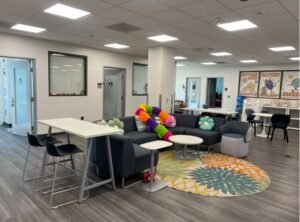
SDSU’s Basic Needs Center in San Diego, Calif. on Tuesday, April 21, 2026. The Basic Needs Center offers students long-term basic need solutions and immediate assistance. (Photo/Armando Rasing II)
Baez described the ECRT and Basic Needs’ strategy to get students into housing as “holistic”, aiming to address the root cause of a student’s situation. Case managers work with students with additional basic needs programs beyond housing assistance depending on their eligibility. Students must have filed a federal student aid loan application and have documentation that an unforeseen circumstance has occurred to be eligible.
“SDSU relies on students self-reporting their housing status, and not everyone adopts the same definition of homelessness,” said Evie Baez, the director of the SDSU Basic Needs Center, on why SDSU does not directly track homelessness. “Students may also decline to report their housing status due to personal reasons.”
Baez added that each student requesting assistance has a unique plan created for their needs. The timeline and process of helping a student move into permanent, stable housing varies on a case-by-case basis depending on the needs of a student or the housing market.
“If they indicate they are without stable housing and their situation is urgent, we will assess and connect them with a temporary housing situation immediately,” Baez said.
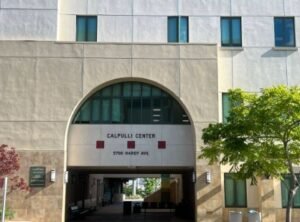
The Calpulli Center, located at the edge of SDSU’s campus, in San Diego, Calif. on Tuesday, April 21, 2026. SDSU’s Basic Needs Center is located on the third floor of the Calpulli Center. (Photo/Armando Rasing II)
Stephan Madrid, a coordinator for the San Diego Rescue Mission, a non-profit homeless shelter, stated that college institutions should keep track of how many unhoused students attend their school.
“In order to properly support them, the first step is documentation so that records can be kept and appropriate support can be provided,” Madrid said.
Madrid added that he thinks that tracking unhoused students would “only be beneficial”, and that the only potential obstacle is students not wanting to disclose their status.
“As long as it can be guaranteed that the information will be confidential, only used to support them and [make] them aware of who this information would be shared with – I don’t see any cons to it,” Madrid said.
Kritzer also believes that there are complications with SDSU’s reliance on students to self-report their housing status. She said that people may come from different cultural backgrounds or have extreme experiences where asking for help may be an uncomfortable option.
“It is embarrassing, at least for me, to ask someone for help,” Kritzer said. “So relying on students to go and ask for help – we’re missing the mark. We should be making students and people feel comfortable enough to ask for help.”
SDSU students’ housing options
Lower-division students, or students in their first two years of college, that graduated high school inside SDSU’s local admissions area do not have to live on campus. SDSU’s local admissions area is considered to be the areas south of state Route 56 in San Diego County to the Imperial County borderline eastward.
Lower-division students that graduated high school outside of the local admissions area have to live on campus during their first two years at the university.
“National and local statistics show that students who live on campus enjoy an increased sense of community and campus connectedness are better prepared academically and graduate at faster rates than those who do not,” said SDSU’s housing department’s campus living guide for the 2026-27 school year. [12]
Once a student becomes an upper-division student, housing options become limited. While these students can apply to live on campus, they are accepted on a first-come, first-served basis. Lower-division students get priority when it comes to the housing options on campus.
“Because on-campus housing is not guaranteed for this population, upper-division and graduate students are strongly encouraged to explore SDSU-affiliated and non-affiliated housing via our Off-Campus Housing resource page,” SDSU’s website states. [13]
Aside from SDSU’s rapid rehousing program and housing on campus, Wesley Housing is a student residence located at the edge of SDSU’s campus that assists college students in San Diego County with finding basic necessities such as housing and food. To receive financial assistance, the student must demonstrate self-sustainability, be a full time student and attend a financial literacy workshop.

The Wesley House in San Diego, Calif. on March 24, 2026. Wesley Housing offers housing and food assistance, and their building is located at the edge of SDSU’s campus. (Photo/Armando Rasing II)
“The premise behind that requirement is that we assist students that help themselves,” said Robert Becerra, Wesley Housing’s housing navigator. “Were we to deliver the assistance up front – that can create a Band-Aid solution that’s not really sustaining the students’ financial well-being over time or providing education.”
Once a student meets all those qualifications, they can apply for one month rent assistance. Becerra added that the biggest challenge he has as a housing navigator is helping clients increase their income enough so that Wesley Housing can assist them in embarking on a new lease.
Kritzer is a graduate student at SDSU and a resident at Wesley Housing. She dealt with homelessness as an adolescent and housing insecurity while obtaining her associate’s degree at San Diego City College.
“In City College, I had to leave a living situation and was couch surfing for a little bit – that was really difficult to focus on school at the same time,” Kritzer said. “There was a lot of instability with housing for me.”
She stated that even though she had experience and knowledge on how to navigate as an unhoused student, there was still fear and uncertainty that bothered her every day.
“It caused so much anxiety wondering, ‘How am I going to get through school, and also where am I going to live,’” Kritzer said. “But I just knew I had to get through school, so I’ll figure it out. But moving to the Wesley House made things so much easier.”
When Kritzer was first accepted into SDSU, she was concerned about expenses if she were to be a commuter student because she lived 30 minutes away from campus at the time of her acceptance. She also felt like housing near campus was too expensive. Through the Welcome Home City program at City College, she was able to get in contact with Wesley Housing.

Wesley House’s food pantry in San Diego, Calif. on March 24, 2026. The Wesley House food pantry has fruits, vegetables, canned goods and more food options available for students. (Photo/Armando Rasing II)
“Financially, it’s so much more reasonable for the rental costs here for me,” Kritzer said. “It’s like a dream. Since I’m a transfer student, being able to step outside my apartment and go to class is a dream.”
Kritzer believes that students should have a safe space to seek assistance and that she believes prevention is the best way to reduce homelessness among student populations. She added that help should be provided “at the first sign of an issue.”
“Expanding programs like the Wesley House is huge,” Kritzer said. “Students who are trying to better themselves and get themselves out of poverty like myself – that’s who we need to be supporting.”
While the number of unhoused individuals in San Diego has decreased over the last year, San Diego still has one of the largest unhoused populations in the country. San Diego has been in the top 10[14] of highest unhoused populations for almost two decades.
Last month,[15] the San Diego Regional Task Force on Homelessness was able to provide services for over 2,500 individuals ages 18 to 24. They also found that there were more people that became unhoused for the first time than people who overcame homelessness.
Kritzer described housing as a “basic human right” and housing instability as “hard, scary and difficult.”
“Living in your car, or living in a motel or sleeping on the street – there’s so many risks to that,” Kritzer said. “Health issues, mental health issues – that is a detriment to the future of our populations [and] our communities.”
- eighth-most populated city: https://www.sandiego.gov/economic-development/sandiego/population
- sixth-largest: https://www.huduser.gov/portal/sites/default/files/pdf/2024-AHAR-Part-1.pdf
- $2,522,: https://www.nbcsandiego.com/news/local/time-to-negotiate-that-lease-san-diego-rents-drop-for-first-time-in-15-years/3958755/
- in the country. : https://www.zillow.com/rental-manager/market-trends/united-states/
- approximately 9,905 unhoused individuals,: https://www.rtfhsd.org/2025-point-in-time-count-shows-7-drop-in-regionwide-homelessness/
- approximately 9,905 unhoused individuals,: https://www.rtfhsd.org/2025-point-in-time-count-shows-7-drop-in-regionwide-homelessness/
- 2025 Real College Survey.: https://www.sdccd.edu/departments/communications/newscenter/articles/2025/food-housing-insecurity-survey.aspx
- University of California Undergraduate Survey in 2024.: https://www.universityofcalifornia.edu/about-us/information-center/university-california-undergraduate-experience-survey-ucues-data-tables-2024
- almost 11%: https://basicneeds.sfsu.edu/sites/default/files/documents/CSU%20Basic%20Needs%20Report%202018-%20SF%20State%20Specific%20Data%20Points%20%20%281%29.pdf
- College Focused Rapid Rehousing Program: https://www.kpbs.org/news/education/2026/02/24/1-in-10-cal-state-students-face-homelessness-this-emergency-housing-program-helps
- $870,000: https://www.sdsu.edu/news/2022/01/sdsus-transitional-housing-for-homeless-students-continues-expand
- SDSU’s housing department’s campus living guide for the 2026-27 school year. : https://housing.sdsu.edu/_resources/documents/2026-27-campus-living-guide.pdf
- SDSU’s website states. : https://housing.sdsu.edu/apply/upper-div-grad
- top 10: https://centerforjobs.org/ca/news/san-diego-again-has-4th-largest-homeless-population-in-nation#:~:text=San%20Diego%20again%20has%204th,steadily%20has%20risen%20since%20then.
- Last month,: https://www.rtfhsd.org/wp-content/uploads/2026/04/HMIS-Data-Newsletter-March-2026.pdf
Source URL: https://eastcountymagazine.org/san-diego-state-university-does-not-track-amount-of-unhoused-students-on-campus/