
Grossmont and Cuyamaca College military and veteran students find connection and support 33
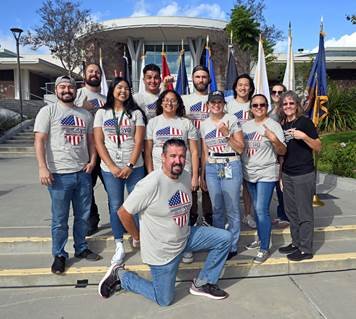
Total Views: 161 The colleges offer award-winning programs that celebrate and honor veterans Photo: Grossmont College student veterans Source: Grossmont-Cuyamaca Community College District November 4, 2025 (El Cajon) – Navy veteran Isaiah Nailon had one clear goal in mind when he enrolled at Cuyamaca College in the spring of 2018: taking the first step toward earning a bachelor’s degree. “That was it,” he said. “Cuyamaca College had one of the best transfer rates to San Diego State University for business administration majors, but everyone in Veterans Services encouraged me, motivated me, and challenged me to dream bigger. ‘Why stop at a bachelor’s degree?’ they said. ‘Why not a master’s?’ It got me to thinking, why not?” Photo, right: Cuyamaca College student veterans Why not, indeed. Nailon not only earned his Bachelor of Science Degree in Business Administration, he went on to complete not one, but two master’s degrees – one in business administration and another in education and counseling. Today, he’s back at Cuyamaca College, paying it forward as the Co unseling and Assessment Supervisor and Acting Veterans Center Supervisor and a School Certifying Official. Nailon’s journey is just one example of the numerous success stories emerging throughout the Grossmont-Cuyamaca Community College District. Similar achievements are also unfolding at Grossmont College, where an impressive Veterans Resource Center has become a focal point for support. At Grossmont College, Navy veteran Kelly Carlson (left) quickly found the Veterans Resource Center to be an essential part of her daily college experience. “I’m here every day, mainly for the computer lab; it’s really quiet, really peaceful, and they have all the amenities that you need,” said Carlson, a biology major who spent six years in the Navy as a gunner’s mate aboard the USS Porter before completing her service at Naval Base San Diego. “The counselors are right across the hall, people are really respectful, and if I ever forget to eat something, I could just go into the kitchen and grab something to eat. They’ve also offered me backpacks, laptops, everything under the sun. It’s truly amazing.” These welcoming resource centers are made possible because of ongoing community support, including funding from the voter-approved Proposition V. The Grossmont College Veterans Resource Center, for example, features an expansive kitchen and living room, private study area, computer lab equipped with 15 new personal computers and printers, and counseling offices. Upstairs , military-affiliated students can relax in a fully furnished, outdoor lounge offering picturesque views of Cowles Mountain, the highest point in San Diego, and Mission Trails Regional Park. The Center’s stockrooms supply hundreds of laptops and Grossmont College backpacks for veterans and dependents in need. Photo, right: Cuyamaca College 2024 Veterans Day Pancake Breakfast Veterans Day Celebrations Both college will be celebrating Veterans Day with activities and events for students and employees on Monday, November 10, 2025. At 9:00 a.m., Cuyamaca College will hold a Pancake Breakfast and a U.S. Marines Birthday Celebration in the Veteran Resource Center (Student Center, I-113). At 12:00 p.m., Grossmont College will host a Salute to Service Luncheon at the Veterans Resource Center (Building 36-100). Both campuses, through their well-equipped Veterans Resource Centers and dedicated student support staff, illustrate why the Grossmont-Cuyamaca Community College District has become a statewide leader in serving military veterans and their dependents in a region with the highest concentration of military personnel in California. Across Grossmont and Cuyamaca colleges, military-affiliated students, who include veterans, dependents, and those actively serving, comprise about 2.5% of the 20,538 students enrolled this fall, according to the District’s Office of Research, Planning, and Institutional Effectiveness. This figure, however, includes only those using VA education benefits and excludes others who qualify but opt to reserve their GI Bill eligibility for future university studies. For instance, Grossmont College estimates approximately 600 military-affiliated students annually, with its Veterans Resource Center logging 1,992 visits during spring 2025. Likewise, Cuyamaca College serves an estimated 400 military-affiliated students each year, with an average of 15 to 20 students visiting its Veterans Resource Center daily. Award Winning Programs Photo, left: Grossmont College veterans graduation celebration, 2025. Veterans outreach and support extends beyond campus. The District is an active member of the Veterans East County Alliance (VECA) and the San Diego East County Chamber of Commerce, and was recently nominated for the Alliance’s 2025 VALOR Veteran Friendly Business of the Year for, among other things, its veteran resources and transitioning programs. The District actively participates in local veteran’s oriented events, such as staffing a booth at the Operation Employment Veteran Career and Resource Fair this fall, hosted by VECA and the City of Santee. In 2024, the East County Economic Development Council recognized the Grossmont-Cuyamaca Community College District with “Partnership of the Decade” honors, in part due to its role supporting and advancing veteran services and workforce training and development. Both colleges have been recognized by The Military Times as Military Friendly Schools, and for the past three years, The Military Times has recognized Cuyamaca College as a “Best for Vets: Colleges” campus. Like its counterpart at Grossmont College, the Cuyamaca College Veterans Resource Center provides a welcoming, modern space designed to help veterans succeed, offering access to technology, study areas, and essential supports, including a fully stocked pantry and kitchenette. Veterans benefit from a range of cost-free resources, including gas cards, book vouchers, hands-on assistance with GI Bill benefits, and educational support for dependents. Laptops, books, calculators, and testing materials are available to borrow. Supporting students on every step of their academic journeys, counselors and dedicated employees at both campuses provide guidance through counseling, career exploration, and the transition from military to college life. These efforts predate even the California Community Colleges’ Vision 2030 initiative, a system-wide roadmap committed to helping veterans navigate the transition to civilian life and higher education. Groundbreaking efforts like the “Veterans Sprint” ensure every veteran’s Joint Services Transcript is reviewed for college credit. Programs
33 viewsMARSHA EDWARDS NAMED NEW HUMAN RESOURCES CHIEF FOR GROSSMONT-CUYAMACA COMMUNITY COLLEGE DISTRICT 12
Total Views: 53 September 30, 2013 (El Cajon) – Marsha Edwards, a 22-year veteran in her field, has started her new post as vice chancellor for human resources for the Grossmont-Cuyamaca Community College District. Edwards, who was born in Oregon and spent much of her life there, said she was intrigued by the job posting for the top human resources job at the East County college district. “When I looked into the position, it seemed like a good fit with my background and experience and would allow me the opportunity to work with two great colleges in a great climate – decision made!” she said. Chancellor Cindy L. Miles said the district will benefit from Edwards’ experience and knowledge in labor law and personnel issues, as well as her skills in contract negotiations. “We are very fortunate to have someone with Marsha’s talents and keen perceptions,” she said. “In these economically challenging times and with the tenuous budget picture, it is crucial to have someone with her adeptness and expertise in personnel management. I am delighted to have her aboard as a member of the district leadership.” Before joining the district in September, Edwards had worked since 2010 as the human resources dean for Clackamas Community College, a 38,000-student, three-campus college based in Oregon City. She also worked during two separate stretches for Linn-Benton Community College, a 23,000-student campus in Albany, first as the employment services manager in the late ‘90s and early 2000s, then as the human resources director for four years prior to her job at Clackamas. She has also held HR management positions with the cities of Lebanon and Portland, Ore. She started her career in 1991 at Oregon State University in Corvallis, where she spent eight years as a personnel specialist, recruitment coordinator and trainer, and simultaneously earned her bachelor’s degree in business administration, majoring in management and minoring in pre-law. She has gone on to earn a master’s in organizational management from the University of Phoenix. “I started my education at Truckee Meadows Community College in Reno when I was around 24,” she said. “I took classes when I could afford it, while raising my family and working, so it was challenging, as it is for so many of our students. When we moved back to Oregon, I was lucky enough to get a job at Oregon State University and continued my education there.” Edwards remembers her first job at a tree farm in Elkton, Ore., grading trees – work she describes as mind-numbingly dull. “Your job consists of standing by a conveyer belt and sorting trees for size and quality for distribution to the local nurseries,” she said. As for her chosen field, one thing that appeals to her is that, unlike her first job on the tree farm, it is never dull. “I enjoy the variety of people and issues I get work with, and that no two days are the same,” she said. “I enjoy working on process redesign and adapting to new technology, basically assisting the organization in finding the best solutions.” And what does she view as the biggest challenge at her new job? “Learning the committee structure and how our processes work here at the district – and, of course, learning new names and faces,” she said. Edwards and her husband, Mike, are now living in Lakeside and spend their spare time house-hunting. The mother of two sons and two step-daughters – all grown – Edwards said her family obligations consist these days of her husband and two Lhasa apsos. “I’m not a big hobby person, but I do have a major weakness for dogs,” she said. Printer-friendly version
12 viewsEAST COUNTY COLLEGE DISTRICT APPROVES BUDGET; PREPARES FOR UNCERTAINTIES 13
Total Views: 50 September 17, 2012 (El Cajon) – Under darkening clouds of economic uncertainty, the Grossmont-Cuyamaca Community College District Governing Board battened down the hatches Tuesday, September 11, passing a $150.4 million budget that prepares the district to weather the storm, should Proposition 30 – the governor’s tax measure – fall short in the November election. “Like the household budget planner who wisely decides not to count on that iffy pay raise for the coming year, this district is planning very conservatively,” said Chancellor Cindy L. Miles. “We’re prepared to serve our students. In the long run, that level of service will be determined by voters.” A $5.6 million projected loss in state funds factored into the district’s 2012-2013 spending plan means funding for about 1,000 fewer students and 310 fewer class sections if Prop. 30 fails. Statewide, the tax measure’s defeat Nov. 6 will result in California’s 112 community colleges losing $338 million in funding and having to turn away 180,000 more students. While mandated to approve its budget in September, the financial realities of the 2012-2013 budget year and the district’s growth for the future won’t be determined until after the fall election. That’s when voters statewide will decide on Proposition 30 and Proposition 38, a competing tax measure financially backed by attorney Molly Munger that doesn’t include any funding for colleges and universities. The governor’s proposal, Prop. 30, would provide funding for all levels of education and other public needs by temporarily boosting levies on sales and individuals with annual earnings of $250,000 and up. Munger is proposing a wider income tax hike to raise money solely for K-12 schools and early childhood programs. Community colleges are closely watching both initiatives because only the measure that passes with the greatest number of votes will take effect. Should that be Prop. 38, higher education would lose altogether. If Proposition 30 passes, the district will be able to serve 1,100 more full-time students by restoring the $5.6 million funding loss and receiving an additional $705,000. East County voters will also be casting their ballots on Proposition V, the district’s $398 million bond measure to renovate and replace Grossmont and Cuyamaca colleges’ aging facilities, technology and infrastructures. It will continue the progress of Prop. R, the district’s 2002 facilities bond measure, by adding new facilities to replace temporary buildings that have long outlived their usefulness, as well as structures too old to renovate. Veterans support centers are also included in the plans for both colleges to accommodate the growing numbers of former service members using the post-911 G.I. Bill to attend college. Funding saga devastating The cuts in this year’s budget come on top of four years of state funding cuts totaling more than $16.1 million, forcing the district to cut more than 1,600 classes since 2008-2009. The waitlist for class seats has grown to more than 12,500 this fall, 15 times higher than it was five years ago. Bill Garrett, president of the Grossmont-Cuyamaca Community College District Governing Board, said he is hopeful that voters understand that given the staggering losses from the state’s anemic economy, revenue generators like Proposition 30 and Proposition V represent the most realistic approaches to restoring much-needed services to students. “As a crucial factor to the economic strength of East County, restoring our colleges would benefit the region as a whole, providing the education and training for jobs, and expanding future opportunities for everyone,” Garrett said. Because the college district receives 94 percent of its funding from the state, it is deeply affected by California’s budget crisis. Unlike K-12 schools that are funded based on the number of students enrolled, funding for community colleges is based on an enrollment cap set by the state. Samantha Elliot, Grossmont College’s student trustee, said she appreciated that the district had prepared its budget in an effort to avoid midyear cuts. “I am very grateful for a budget that prepares for the worst, but hopes for the best,” she said. For more information about the colleges and the district, go to www.gcccd.edu Printer-friendly version
13 viewsBLOCK’S BILL TO START A 4-YEAR BACCALAUREATE PILOT PROGRAM AT GROSSMONT AND CUYAMACA COLLEGES CLEARS COMMITTEE 11
Total Views: 47 Program to be funded by workforce partners in community and through student fees May 23, 2011 (Sacramento) – To help meet demand for more college graduates to help drive California’s economy, Assembly Higher Education Chair Marty Block (AD-78) has authored legislation to look at alternate ways to help students achieve a baccalaureate degree. AB 661 would allow Grossmont-Cuyamaca Community College District and San Mateo County Community College District to establish baccalaureate degree pilot programs in subject areas where workforce need is high. Yesterday, AB 661 cleared the Assembly Higher Education Committee without opposition. “At a time when more students are relying on community colleges to fulfill their higher education goals, this legislation would not only expand access for these students, it would also help address local workforce needs in areas like health, biotechnology and other in-demand professions,” said Assemblymember Block. “Offering a quality four-year degree at the community college-level would also open the doors to more students who might not be able to attend a four year institution. By allowing students to complete the baccalaureate degree at a college where they have already demonstrated success, this legislation will help enhance college competition rates and promote greater workforce development in the local community.” Under this legislation, Grossmont-Cuyamaca Community College District and San Mateo County Community College District would be able to establish one baccalaureate degree pilot program per campus. The purpose of the baccalaureate degree pilot program is to promote economic development by preparing people for occupations that are in demand and require a baccalaureate degree. The districts shall identify and document unmet workforce needs in the subject areas of the baccalaureate degrees to be offered and offer baccalaureate degrees in those subject areas possessing unmet workforce needs in the local community. The pilot programs under AB 661 would sunset eight years after the first class of students begin the program and the districts would be required submit a report to the Legislature examining the program’s success. Additionally, any campus that offers a baccalaureate degree must be able to offer the program without impacting current programs. What this will mean is that campuses will have to rely on funding from workforce partners – which provides the additional benefit of strengthening the relationship that campuses have with their community businesses. The districts may also charge baccalaureate degree-seeking students a fee in an amount to be determined by the district’s governing board to administer the baccalaureate degree pilot program. Nineteen other states including Florida, Texas and Hawaii have authorized their community colleges to grant bachelor’s degrees. California ranks 43rd out of the 50 states in the proportion of its college-age population that attains a baccalaureate degree. Allowing community colleges to confirm bachelor’s degrees is one potential option for expanding access and degree production. AB 661 now goes to the Assembly floor for a vote. Democratic Assemblymember Marty Block represents the cities and communities of Bonita, Chula Vista, Lemon Grove, San Diego, and Spring Valley. Printer-friendly version
11 viewsGROSSMONT-CUYAMACA LEADERS SERVE UP IDEAS—AND PIE–AT NATIONAL “INNOVATIONS IN COMMUNITY COLLEGES” CONFERENCE 5.1K
Total Views: 31 March 5, 2011 (San Diego) — A national conference that brought more than 1,700 representatives of two-year colleges to San Diego shined a spotlight on the Grossmont-Cuyamaca Community College District, from sessions by faculty and administrators discussing innovative ideas in education to the more than 100 district volunteers who helped ensure the event ran smoothly. The conference, Innovations 2011, which ended Wednesday, was hosted by the Grossmont-Cuyamaca Community College District and the San Diego Community College District. Participants came to the Hilton San Diego Bayfront from community colleges across the United States, Mexico and Canada. More than 400 forums, workshops, keynote presentations and roundtable discussions were offered on myriad topics at the conference sponsored by the League for Innovation in the Community College, an international consortium of community colleges and their districts, and 150 corporate partners. Faculty and administrators from Grossmont and Cuyamaca colleges, as well as the district office, presented or took part in eight conference events, including one presentation – aptly called “Diet for a Small Budget: Thriving on PIE” — that had the two college presidents, the chancellor and a vice chancellor dressed as chefs and giving away boxes of mini-pies. “It was truly a Herculean effort on the part of our volunteers who did everything from stuffing giveaway bags and registering people to putting together slideshow presentations and manning exhibit booths,” said Cindy L. Miles, chancellor of the Grossmont-Cuyamaca Community College District and former top executive of the League. “The volunteers did a fabulous job, as did our faculty and administrators taking part in the wealth of workshops and presentations offered. We are proud to have been able to showcase innovative academic programs and the latest high-tech teaching tools.” She added, “There also was such a spirit of collaboration and a sense of ‘we’re all in together’ as we shared strategies on how best to meet student needs during this time of unprecedented demand and funding cuts.” Music groups from Grossmont and Cuyamaca colleges provided entertainment during breaks in the session. Cuyamaca’s ASL Choir, the Grossmont Jazz Combo and the Grossmont Afro-Cuban Combo performed outside the exhibit hall. Miles joined Constance Carroll, chancellor of the San Diego district and Francisco Rodriguez, superintendent and president of MiraCosta College, for a special session presentation titled, “Austerity and Innovation: Strange Bedfellows or Creative Confederates?” A packed conference room listened as the three shared creative steps they are taking to serve students despite starkly reduced resources. Miles said declining state support and stiffer competition from the university systems for remaining resources means community colleges may have to redefine their roles in the higher-education spectrum. “We are going to be tested and we have to revisit what it is what we are about – what are our missions?” said Miles, adding that the district, like others across the country, is facing the worst financial crisis it has ever experienced. Rodriguez and Carroll expressed similar thoughts. “Not everything is a priority,” Rodriguez said, noting how difficult it is for educators to evaluate programs and offerings as they consider what to cut. “Things that heretofore have been unspeakable in terms of the budget ax are now on the table.” The biggest question, Carroll said, is who should have access to community colleges. “Senior citizens are being excluded as more of the community learning courses are being cut,” Carroll said. We need to have an open discussion on these types of decisions. There are philosophical issues here.” Miles later joined the group of “chefs” – Sunita Cooke, president of Grossmont College; Robert Garber, interim president of Cuyamaca College; and Sue Rearic, vice chancellor of business services for the district, to share tested recipes for learning while “downsizing course menus and streamlining the organizational kitchen.” Their chef’s attire and accoutrements drew laughter, but the talk was anything but comical as they discussed a $15 million budget shortfall, losing 645 part-time employees and 60 full-timers in the past two years, and cutting more than 1,000 course sections. “It’s gut-wrenching what we have to do to balance budgets,” Cooke said. “If anybody thinks this is not serious – let me just say we spend every waking hour wracking our brains on how to survive these cuts.” The various flavors of pies handed out to audience members represented the two kinds of PIE that play key roles at the district. One kind of PIE is planning, implementation and evaluation, and the other is purpose, inquiry and entrepreneurship. Both are used to find new ways to deal with a tight budget. “We are saying we can manage these issues and problems,” Miles said. “That’s a big part of our jobs as leaders.” Other presentations included “They Have an App for That!,” in which Cuyamaca College faculty Jennifer Smith, Therese Botz and Kelley Nielsen and student mentors showed how student-generated videos can be posted on iTunesU for instructional use, as well as how another computer application – Skype – can be used as a teaching tool. Jerry Buckley, senior dean for research planning and institutional effectiveness, and Chris Hill, former president of the Grossmont College Academic Senate, headed a forum on integrating college planning, budgeting and assessment. Cuyamaca College’s Dr. Julianna Barnes, vice president of student services, and Tammi Marshall, a math instructor, led a forum titled, “Learning Communities and the First-Year Experience: Promoting Success in Basic Skills.” Another Cuyamaca group – Dr. Kathryn Nette, a biology professor; Laurie LeBlanc, a chemistry professor; and Diane Kew, instructional lab assistant, led a session, “Facilitating Student Learning in the Sciences Through Interdisciplinary Case Studies.” Cuyamaca English professors Lauren Halsted, Mary Beth Graham and Seth Slater presented a session on how Faculty Inquiry Groups can enhance professional development. For more about the colleges and the district, go to www.gcccd.edu. Printer-friendly version
5.1K viewsEAST COUNTY COLLEGE DISTRICT GETS TOP MARKS IN AUDIT—AGAIN 2.9K
Total Views: 34 December 23, 2010 (El Cajon)– The Grossmont-Cuyamaca Community College District received top marks from auditors this month—for the seventh consecutive year. The state-mandated audits are conducted by a team of a half-dozen independent auditors who scrutinize the district numbers in an ongoing process that starts anew at the start of every fiscal year. The reports presented at a governing board meeting last Tuesday give the district a clean bill of health on five separate audits for 2009-2010. The certified public accounting firm of Christy White Accountancy gave “unqualified” or “clean” opinions for the district’s general audit; its alternative pension plan; Grossmont and Cuyamaca colleges’ foundations; and the district’s auxiliary. The governing board is expected to receive financial and performance audits in January for its Proposition R construction fund, the $207 million local bond approved by voters in 2002. An “unqualified” opinion is the best type of report to be issued from an external auditor, indicating no deficiencies in internal control or compliance, accountants James Hawley and John Dominguez told the governing board. The auditors said the college district’s business department does an outstanding job of recordkeeping, with a well-organized tracking and reconciling of income and spending that helps the auditing process go smoothly. Governing Board President Bill Garrett said the board is always pleased to see such strong audits. “They verify the district’s ongoing history of careful and deliberate management of public resources and are proof that we have accurately accounted for the collection and expenditure of taxpayer monies,” he said. Chancellor Cindy L. Miles said clean audits are critical because they provide an independent accounting of the district’s ledgers and are used by financial institutions, government agencies and others for bond ratings, fundraising, or oversight purposes. “Years of clean audits reflect the conscientiousness of district and college staff,” she said. “The public can be assured we are transparent in our handling of taxpayer dollars.” At a time when the district is already suffering from a $15 million budget shortfall for the current year, the audit report noted the state’s reduced funding while enrollment is climbing could further affect the district’s finances. The state only provided funding for the equivalent of 17,939 full-time students, leaving almost 3,000 students unfunded. The district will face additional budget challenges in the 2010-11 fiscal year with a $13 million delay in funding from the state, the auditors said in their report. With enrollment figures on an upward trajectory, the district is once again expected to have more students than its funding apportionment from the state. Miles said the district’s ongoing cost-cutting has been painful, with course reductions for students and vacant positions going unfilled at the same time there’s increasing student demand. But these actions, along with the clean audits, reflect the district’s commitment to prudent spending, she said. Additional highlights of the audit: • Net assets for the fiscal year increased by nearly $8 million due to an increase in financial aid revenue and decreased interest expense related to long-term debt. • Total assets increased by $2.8 million or less than 1 percent from the previous year, mostly based on increases in capital assets. • Total liabilities decreased $5 million, or 1.95 percent, mainly due to lower annual payments of general obligation bonds and accrued interest in 2010. • Total net capital assets increased $20.3 million, or 8 percent, primarily due to three construction projects at Grossmont College: a multistory parking structure, health and sciences complex and the student & administration services renovation; and at Cuyamaca College, the learning resource center expansion and remodel. The audits presented to the governing board are available at www.gcccd.edu/districtbudget/Annual-Audit.asp. For more information about the district, go to www.gcccd.edu. Printer-friendly version
2.9K viewsCA COMMUNITY COLLEGES CHANCELLOR: BUDGET CUTS A “TRAGEDY” 6.9K
Total Views: 39 Head of nation’s largest college system faults two-thirds rule for impeding passage of state budget; remarks made during visit at Cuyamaca College August 27, 2010(El Cajon)–Grossmont-Cuyamaca Community College District Chancellor Cindy Miles welcomed California Community Colleges Chancellor Jack Scott to Cuyamaca College on Thursday for a candid discussion with the region’s community college and business leaders. Topics ranged from the state budget crisis to a bill just passed that will smooth transition for students from two-year campuses to state universities. Scott spoke with passion about his years working in the higher-education arena, first as an educator and adminstrator, then as a legislator, and currently as the head of the largest college system in the nation. “Sometimes in the midst of dealing with crisis, we forget what a wonderful mission we have…112 colleges, 2.8 million students,” Scott said. “We are in the business of transforming lives and it is one of the most satisfying things to engage in, seeing students come away with dreams fulfilled, with knowledge and skills they are going to use the rest of their lives.” He praised the work of Grossmont College and Cuyamaca colleges in addressing students’ needs in these challenging times. Community colleges throughout the state are facing higher enrollment and a sharp reduction in the number of course sections offered due to the budget losses. Chancellor Miles paid tribute to Scott’s effective leadership in Sacramento, particularly in promoting stronger linkages between the California Community Colleges, the California State University and the University of California systems. Scott’s vast experience with community colleges is invaluable, she said, at a time of unprecedented budget cuts and swelling enrollment. “We are practicing an art we are not good at – having to say no to our communities and students as we are forced to reduce our offerings,” Miles said. “At almost 30,000 students, we are bursting at the seams and still have 15,000 on wait lists as a result of our having fewer classes available.” Scott described as a “tragedy” the severe funding cuts the community college system has had to endure in recent months due to the state budget crisis, noting last year’s 8 percent loss and the challenges currently posed as the state Legislature’s budget stalemate lingers. “Right now, the picture in California is not very encouraging,” he said. “Part of the problem is structure. We are one of only three states that require a two-thirds vote in both houses to get a budget. The partisanship in Sacramento and Washington has only increased. That doesn’t help matters and I know what a hardship this presents… If this continues into September, some colleges will have difficulty meeting payroll. It’s a desperate situation and I’m very concerned about it. “We all know that during this recession, unemployment has been high in California and a lot of people are out of work and wanting very much to come to our community colleges to take advantage of the wonderful career-technical programs offered. Veternas are coming to us in big numbers – 75 percent of veterans in California who receive the GI Bill have come to community colleges. In May, we saw the highest number of high school graduates in the history of California.” Scott’s talk took a brighter turn when he spoke about a historic bill passed in Sacramento this week that would guarantee admission to a CSU campus as a junior for students who obtain a community college transfer degree. This piece of legislation, Scott said, will save the state between $150 million to $200 million annually – monies he said should be used to widen access to higher education at a time when campuses across the state are cutting back classes. The bill, SB 1440 by Sen. Alex Padilla, was approved with solid bipartisan support and no opposing votes and is on its way to the governor. The Grossmont-Cuyamaca Community College District actively supported the legislation. “Students will need no more than 60 units to transfer – 39 to satisfy general ed requirements of the CSUs and the additional units for majors or areas of emphasis,” Scott said. “When you finish, you get an associate degree and transfer. “Presently, the average community college who graduates from a CSU does so with 162 units. If that can be reduced to 135 units, you can see how it will save the state money and save the students money.” “SB 1440 recognizes the need to streamline the transfer process and provides an improved, more efficient pathway between California Community Colleges and California State Universities,” Chancellor Cindy L. Miles and GCCCD Governing Board President Bill Garrett wrote in a July letter to California legislators signed by trustees, faculty, staff, students and administrators. “…community college students transfer to a California State University with an average of 80 semester units when only 60 units are required. By simplifying and increasing the efficiency of the transfer process for community college students, we save our students precious resources and open up our classrooms to additional students, saving the state approximately $160 million annually in increased access.” The letter further noted that reducing the amount of time it takes for students to transfer frees up space for some 40,000 additional community college students and 14,000 CSU students annually. Grossmont-Cuyamaca Community College District serves the East County region of San Diego County and beyond to the Imperial County and Mexican borders. The two community colleges that make up the district, Grossmont College and Cuyamaca College, serve nearly 30,000 students per semester, providing workforce training and basic skills education and preparation for transfer to four-year-institutions. For more information, go to www.gcccd.edu. Printer-friendly version
6.9K views