
HOSPITALS ARE DUMPING HOMELESS SENIORS WITH SERIOUS MEDICAL CONDITIONS, ADVOCATES FOR HOMELESS REPORT
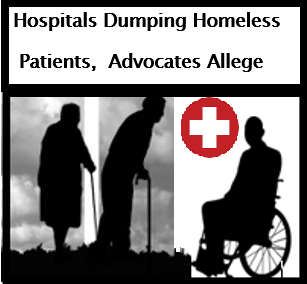
Advocates describe “crisis,” call for state, county and city of San Diego to take action By Miriam Raftery Hear our interview aired on KNSJ April 16, 2023 (San Diego) – Last year, hospitals in San Diego County discharged over 500 vulnerable patients onto the streets late at night in violation of state law, according to Amnie Zamudio and Joanne Standlee, co-founders of Housing 4 The Homeless (H4H). In an interview with ECM, they described dumping of homeless or indigent patients, many wearing only hospital gowns and booties. Those discharged after midnight included seniors with dementia, people in wheelchairs, patients with catheters, and an elderly man with a broken hip. Homeless advocates call for action, contend hospitals committing “crimes” H4H has sent a letter urging the chairs of the Assembly and Senate Human Services committees to hold hearings on the “crisis.” They also held a press conference in late March calling on San Diego Mayor Todd Gloria, the City Council, and the County Board of Supervisors to open the Homeless Resource Center 24 hours a day, 7 days a week to provide vulnerable discharged patients with a safe place to rest, eat, and access wrap-around case management. “Local area hospitals are committing crimes in plain view every day of the week with no consequences. While homeless individuals are being held to the letter of the law regarding public habitation violations, hospitals are being given free rein to blatantly break the law which directly endangers lives,” Zamudio stated in a press release. A state law,SB 1152, took effect in January 2019 and was supposed to prevent hospitals from dumping poor or homeless patients onto the streets, particularly those requiring expensive medical care, instead of placing them with a homeless shelter or keeping in the hospital. The law requires that patients be provided proper clothing, The law requires hospitals to provided screening and stabilizing treatment, and to provide weather-appropriate clothing before releasing such patients. But the reality is far different. Zamudio and Standless say that they are horrified by the reality. “H4H watches in horror as unsheltered individuals are not offered even the most rudimentary requirements of this bill such as food, weather-appropriate clothing, screening for infectious diseases and vaccinations,” H4H’s release contends. Advocates detail mistreatment of patients “dumped” onto streets by hospitals regionwide Standlee (photo, right) told ECM that Zamudio goes out into the night to help those patients dumped onto the streets between midnight and 5 a.m. and has documented each case with photos, though to protect the privacy of those victimized, they are not releasing the images. “All of them show people dire straits,” says Standless. “They are dragging themselves across the sidewalk to a bus stop,” sometimes after being given a buss pass, only to wait hours even in cold and rainy weather, since buses aren’t running. “Some have defecated all over themselves…They are in a bathroom desert, so there is no place for them to use the toilet,” Standlee adds. Zamudio and Standless told ECM that dumping of homeless patients including seniors is being done by both public and private hospitals across our region, including UCSD Medical Center, Scripps Mercy Hospital, Kaiser Permanente, Sharp Grossmont Hospital, and Alvarado Hospital. “I’ve gotten calls from people discharged from Grossmont Hospital who are homeless, saying ‘I’ve been discharged, can you guys please provide mewith a hotel room. I’m disabled. I’m in a wheelchair. I have nowhere to go,” Zamudio says. A veteran with a broken hip was discharged from Alvarado Hospital late at night onto the streets, Zamudio recalled. “I had video of Scripps Mercy dumping a homeless woman in front of the San Diego Homelessness Response Center before it opened,” she said,adding that H4H called for an ambulance to take her back to the hospital. The same day, they had to call an ambulance to return an elderly man to a hospital and demand that he be transferred to a skilled nursing facility. In another case, H4H got a call to help a 72-year-old woman in a wheelchair who had just been discharged. Finding shelter space for seniors is particularly challenging since by law, anyone 55 or older must be placed in a bottom bunk. But even though a shelter had a bottom bunk available, the facility refused to take this woman, because she couldn’t maneuver her wheelchair to shower unassisted, according to H4H. The advocates had to call an ambulance, even though she’d been dumped near a hospital, to get them to readmit her and after advocacy by H4H, agree to refer her into a skilled nursing facility. She describes another patient as a “wonderful woman” whose “landlord dumped her at Alvarado Hospital and evicte4d her while she was there.” The patient was admitted and discharged by hospitals four times, including UCSD, Scripps Mercy and Alvarado “all while wearing a pink fluffy robe and house slippers.” H4H contacted her sister, who convinced a hospital to administer a cognitive impairment test which showed the woman had dementia. “A challenge with seniors is that many suffer from cognitive impairment,” says Standless, noting that many may not understand a discharge plan when agreeing to one. “No one is really tracking or advocating alongside our older adults experiencing homelessness. .This happens all day and all night long.” In yet another troubling case, an elderly person discharged by Scripps was aided by H4H after a concerned community member called for help. During the intake process atH4H, she wandered off, so advocates called police. They learned that there was already a silver alert reporting her as a missing person, filed around two weeks earlier. It’s unclear whether the hospital didn’t realize she was a missing person, or perhaps didn’t reveal this due to privacy law concerns. “We are specifically speaking about people who were discharged—not those who left against medical advice,” Standlee points out. Despite the dangerous conditions under which many patients have been discharged, based on their observations, Standlee and Zamudio don’t believe the blame lies primarily on hospitals, which are overwhelmed.