
FEBRUARY IS AMERICAN HEART MONTH: DO YOU KNOW WHERE YOUR NEAREST AED IS? 3.7K
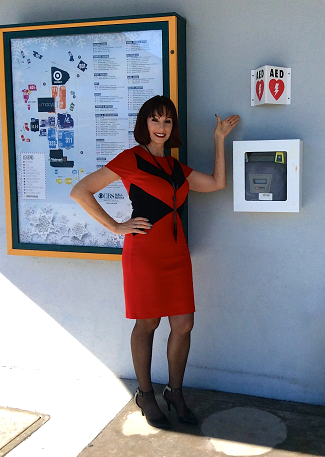
Total Views: 40 East County wife and mother says the life-saving devices should be easier to find than a gourmet cup of coffee By Lora Watters February 27, 2018 (San Diego’s East County) — Something caught Susanne de La Flor’s eye as she strolled through Grossmont Center last spring. It was not a display for a best-selling author in the Barnes & Noble window, nor a life-size cardboard cutout promoting a funny animated movie at Reading Cinemas. It was an Automated External Defibrillator on a plain gray stucco wall, between the post office and CVS Pharmacy located adjacent to the popular East County mail. Ever since her husband of 26 years, George de la Flor, suffered sudden cardiac arrest and subsequent brain damage in 2011, Susanne has always made note of AED devices in public places. But there was something special about this AED. It was located outside. Immediately Susanne recalled the day in June 2011 when George, a civil litigation attorney with a practice located in La Mesa Village, collapsed while working out in a hotel gym on a family vacation to Florida. “When I got to the gym, I saw my wonderful husband lying there lifeless,” Susanne recounts. Fortunately, one other person was working out at the gym that day – a surgeon who began giving George CPR. He was able to keep George alive, but unable to restore consciousness. “The doctor kept screaming for an AED, but there wasn’t one in the gym,” Susanne says. “It took an hour and a half for the paramedics to arrive – the longest 90 minutes of my life.” George survived through those long 90 minutes, and after spending six weeks in the ICU, he and Susanne returned to their Mt. Helix home. However, life would never be the same for the couple and their then-teenage sons. Due to the extensive delay to get a defibrillator to him, George had suffered what is known as an “anoxic brain injury,” resulting in severe impairment to his short-term memory. The injury forced him to end his law career – the only job he ever wanted. “This was an extremely difficult adjustment for a man whose previous memory was a steel trap,” Susanne says. “Had there only been an AED installed at that gym, where there certainly should have been one, it would have meant all the difference in the world for George and our family.” (photo, right: George and Susanne de La Flor) On its website at www.Heart.org , the American Heart Association explains that AEDs allow bystanders to help in a cardiac event where defibrillation may be needed. The units are portable, and people outside the medical industry, including first responders, can use them. At redcross.org, the American Red Cross even notes there is liability protection for people who rescue others with an Automated External Defibrillator, through the Federal Cardiac Arrest Survival Act of 2000, and through specific AED laws and regulations in all 50 states. The American Heart Association also notes that calling 911, giving CPR, and using an AED can be combined to improve survival from a sudden cardiac arrest, like the one George went into in the Florida gym. Back at home, with George needing to close his law practice, it was now up to Susanne to provide the family’s income. Having worked such varied jobs in the past as a circus performer, makeup artist, and the office manager in George’s firm, the gregarious redhead found a new career as an account executive in litigation support services. Always one to turn negatives into positives, Susanne then set out to prevent the cardiac tragedy that permanently changed the de la Flor family from happening to other families. She became an advocate for heart health, SCA and heart attack prevention, and especially, for greater placement of those defibrillators that might have made a full recovery for George possible. “I would like to see mandatory placement of heart defibrillators in every business across the U.S., and in key locations such as on busy streets and public gathering places,” she says. “This will create a lifeline for people who need them in a cardiac emergency, like that moment my husband did.” Which brings us back to that AED in Grossmont Center. While you see many defibrillators installed inside stores, gyms, and public buildings around San Diego County, you rarely find them outside. The outdoor device at the mall prompted Susanne to launch a social media challenge. Sort of her own cardiac version of The Bucket Challenge, she asked her Facebook followers to post a picture of any outdoor defibrillator in San Diego County, and even offered $20 as a reward for each post. Though she received many likes and comments, no one found an external AED in addition to that one in Grossmont Center. “One friend said if she found an outdoor AED, she would post it and not take the $20, and my son asked if the contest was open to family members as well,” Susanne says with a laugh. “But unfortunately no one posted an outside AED in San Diego County.” Susanne stresses it’s important to have AEDs outdoors because there they can be seen easier, and they will be available in the event a heart emergency occurs after business hours. “What if the store is closed?” she says. “Does cardiac arrest only happen between 9 a.m. and 5 p.m.?” Susanne would like people to find an AED just as easily as they seem to find Starbucks store nowadays: on every other block. The Red Cross echoes these sentiments, saying on its website that all Americans should be no more than four minutes away from a defibrillator, and a person trained in its use. Over the past seven years, Susanne has been campaigning for AEDs to be placed in San Diego’s outdoor areas with high foot traffic, or where large public events, like concerts or street fairs, occur. Similarly, heart.org suggests that the devices “be placed in public
3.7K views