

OH DEER! JULIAN BACKCOUNTRY TRIP HAS DELIGHTS IN STORE
Story and photos by Miriam Raftery October 1, 2010 (Julian) –If you’re heading up to the Julian Apple Festival this weekend, you’ll find plenty of sights to see along the way. This time of year, watch for wildlife and glimpses of fall foliage as the trees begin to acquire their autumn shades of splendor, though the most spetacular fall colors are still a couple of weeks away in most areas. Still there are plenty of attractions right now to make a trip to the mountains worthwhile. I recommend starting by exiting I-8 at Lakeside, then driving up Highway 79 (which becomes Highway 78) through Ramona, Santa Ysabel and Wynola to Julian, then head south on Highway 79 past Lake Cuyamaca and Green Valley Falls before rejoining Highway 8. Along this route during the past couple of days, I’ve seen seven deer and several flocks of wild turkeys, mostly in the early morning and late afternoons. In Santa Ysabel, stop off for some famous apple-walnut bread or one of the other many choices at Dudley’s Bakery (www.dudleysbakery.com) , or visit the Julian Pie Co. (www.julianpie.com) for some piping hot pie. (My personal favorite: the apple-berry crumb-topping pie.) As you pass through Wynola and on up to Julian, watch for the Julian Mining Company (www.julianminingcompany.com) on your left. Here, you can taste freshly-pressed cider at a cider mill, let the kids run wild in a pumpkin patch or petting zoo, or try your hand at panning for gold. The property is along a creek where the original gold find was made in Julian, which became a hub of hard-rock mining in the 19th century. They also have bags gemstones you can buy for use in a sluice, or shop at a country store complete with everything from scented handmade soaps to arrowhead replicas and coonskin caps for the kids. A horse-drawn carriage ride through the historic gold rush town of Julian, at $7 a person, will provide you with the rich history of the town and its founders. While in Julian, you can choose from three apple pie making shops and a wealth of other stores offering crafts and quaint gifts, including hand-woven items and more. Art galleries display a wide-range of artwork by local artists and artisans, including portrayals of wildlife, scenics, and more. ( In one, a pair of clucking chickens followed us inside.) Melodramas by Doves and Desperados are held regularly on weekends, reliving Julian’s wild western heritage. There are also museums and gift shops hawking western memorabilia. Savor winetasting at several wineries, including the award-winning Orfila Vineyards and Witch Creek Winery, as well as Menghini and Jenkins wineries. Visit a u-pick apple orchard for fresh-off-the tree apples, such as www.wynolafarms.com. Head down to the Menghini winery grounds for apple festival activities and live musical entertainment. The Eagle and High Peak Mine at the end of “C” street north of town offers tours open to the public of Julian’s famed hard-rock gold mine. You can also visit a gem and mineral shop on the premises. Another option is to take a one-mile “gold mine train” ride at Smith Ranch (www.pioneerways.com), where you can also explore an old mine and pan for gold. The ranch offers special seasonal tours such as Apple Days, Thanksgiving Train Adventure, and Julian Christmas Train Express. Julian has many eateries in or near the town, from cafes and a barbecue pit to fine dining at Jeremy’s on the Hill (www.jeremysonthehill.com) or the Julian Grille (historic home of the Robinsons, freed slaves who founded the Julian Hotel.) If you can, stay over at one of Julian’s many wonderful bed and breakfast inns. For affordable charm, Julian Meadow View Inn (www.julianmeadowviewinn.com) is a good bet. Enjoy a leisurely stay, whiling away time on an outdoor wooden swing while watching squirrels and blue jays at an outdoor bird feeder, then savor spectacular sunset views over the mountains from the comfort of your pine-walled cabin-like rooms. Other options including the historic Julian Hotel (www.julianhotel.com) or the four-star Orchard Hill Country Inn (www.orchardhill.com) , as well as Pine Hills Lodge (www.pinehillslodge.com) nestled in the woods just outside of town. Drive home past Lake Cuyamaca (www.lakecuyamaca.org) , where you can rent boats or take the family fishing. Pass through a “ghost forest” burned during the 2003 Cedar Fire. You’ll pass several campgrounds on your drive back towards civilization; my favorite is Green Valley Falls which still had water flowing over the weekend—before yesterday’s torrential rains. You’ll come home refreshed in mind, body and spirit after a day trip or staycation in East County’s delightful mountain towns. Find a full list of activities and events in Julian at www.julianca.com. Printer-friendly version
RIDING THE RAILS: REDISCOVERING SAN DIEGO’S HISTORIC PAST
All aboard! Pacific Southwest Railway Museum in Campo By Dennis Richardson August 29, 2010 (Campo) — A cool breeze whistled in our ears as the Golden State Diesel- Electric train rumbled across the Campo Creek trestle, straight toward a tunnel blasted through a mountain. Three large owls soared through the darkened tunnel as we journeyed back in time. Our trip began Sunday morning. After hearing about train rides at the Pacific Southwest Railway Museum in Campo, my wife and I decided that rediscovering San Diego’s East County heritage would be a great way to spend the day. So we drove east on Highway 94, which was recently designated a state historic highway. It’s also one of the most scenic two-lane highways in our County. I found myself traveling back in time to when I was young, going on Sunday drives to the mountains with my parents in the late 1950s. Many historic sites from the ’50s can still be seen along the route; if not for the modern cars it would be hard to tell the difference. "All aboard!" conductor Richard Pennick shouted as we pulled into the station just in time to get our boarding pass for the Golden State Excursion morning train ride on the Pacific Southwest Railway. We learned that late arrivals who hold the train up for departure as they are speeding into the parking lot are cordially called "dusters" — and we were almost among them. The conductor greeted us warmly and helped us board the train, which is powered by a 1939 Diesel-Electric locomotive. As the doors closed, the horn blew and the train started moving. The conductor introduced himself as he clipped our tickets. We heard the sounds of the train, clip clap, along with the squeaking of wheels, feeling the rhythm as the train rolled forward down the tracks. Soon after leaving the train station we approached a road crossing near the Campo Trading Post Market. The crossing arm lowered and the train’s horn blew, giving warning that we were coming so that traffic stopped for our train. Normally I am on the other side, driving the car and waiting on the train; at that moment I felt the power of the train. We meet a very nice family of four from Serra Mesa: John McMurria, Marion Wilson, three-year-old Lyttle and 17-month old Miller. The kids had a great time walking around between all three cars, parents in tow. They talked to the conductor, ate lunch that their parents had brought, and felt the wind on their faces as they stood next to the train’s brakeman, Bruce Paulis, while sucking on lollipops. We enjoyed the beautiful natural sights as our journey continued through secluded high desert mountains of East County. During the first part of the ride, the locomotive was in the back, pushing the train cars. The brakeman was positioned in front, facing the direction we headed, keeping an eye out for hazards on the tracks. We savored blue skies, clean air and open spaces, observing the beauty of nature while enjoying the comforts of the train. We saw ranches, cattle, horses, mountain quail, manzanita growing from the sides of rock faces, wild turkeys under shady oak trees, and birds of prey soaring on lofty thermal air currents. Our conductor explained in detail how this highly regulated train ride is run. The federal government inspects the train and has oversight of its operations. The people who run the train, restore old trains and operate the museum are all volunteers. Those who run the trains are well trained and must follow strict rules and regulations. Their love of the trains is obvious; you would think they were all highly paid professionals based on their approach to their tasks. (If you love trains, too, the museum is actively seeking more volunteers.) Each trainman carries a pocket watch-and all are synchronized before the train ever leaves the station. Many of the passengers had cameras and posed with the conductor,engineer and brakeman. We passed a sign that read "Dog Patch" and learned that it originated from a 1950’s biker bar that was located on old 94. We squeaked over the Campo Creek Trestle, which drops off to the dried river bed below, ending the first part of our journey at the international tunnel, where the Mexico and United States border’s meet. (Editor’s note: until recently, train trips to Tecate, Mexico were offered out of the Campo depot, including a section across an elevated trestle across a towering gorge. But a fire damaged tracks in Mexico; trips to Tecate, famed for its brewery and other attractions, may resume if repairs are completed south of the border.) On the trip back to the station, we saw a sign marking the Pacific Crest Trail, which originates at the Mexican border and heads all the way north to Canada. Rail signposts state how far from San Diego we are (63, at one point). It’s a tribute to the builder of this short rail, John D. Spreckles, that this line exists. As we pulled in for the end of our hour-long journey, passing wildflowers in bloom, we learned that this short line also was used for taking freight and people to El Centro, where they could link up to trains leading to other parts of the country. Our adventure was not yet over, since we took time to visit the Museum. Founded in 1961, the Museum which houses over 80 types of railroad equipment to wonder over, walk through and touch. The Museum is a story of its own, with friendly hosts eager to answer questions and share their wealth of historical knowledge and lore. The Campo train ride and Pacific Southwest Railway Museum were delightful destinations that allowed us to experience riding the rails through San Diego’s backcountry and bygone times. The cost is affordable, too.Visiting the museum costs $5 for
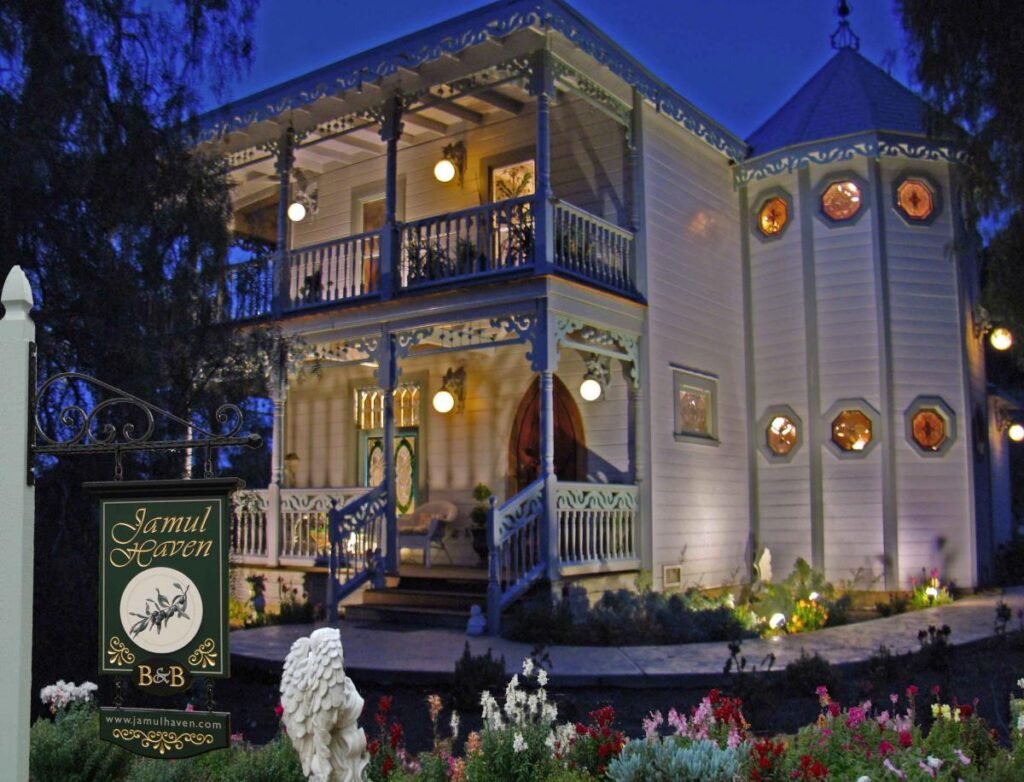
JAMUL HAVEN: FEEL A WORLD AWAY IN 30 MINUTES
A”Staycation” in East County By Rachel Ford April 2010 (Jamul) — Jamul Haven is an 1890 Victorian mansion that has been lovingly transformed into a luxury bed and breakfast. Situated within 30 minutes of downtown San Diego, this European style bed and breakfast is nestled in a picturesque valley and is well worth a visit. Pulling onto the gated six-acre property, you’ll find the grounds and house are overwhelming in their exquisite beauty. The house looks perfectly situated, exuding warmth as you approach as if it has been waiting for you all along. Mama, a retriever mix, welcomes your arrival. Immediately you are transported to another time and place. William and Marianne Roetzheim have been married 28 years; innkeeping happened by surprise. Marianne is an occupational therapist and gourmet chef. William, an accomplished poet and playwright, has published seventeen books. He sold his second soft-ware company and “retired.” At that same time he started looking around for his next project, and found it next door. Friends with the former owners of Jamul Haven, they purchased the house and spent three and a half years renovating it. Marianne appointed all the rooms at Jamul Haven, and according to Bill had been shopping for twenty years. She appears to have a shopping guardian angel that leads her on her way and never lets her pay full price. The rooms, Celtic, Peacock, Rose, and Asian, are decorated with meticulous care and love. The peacock room displays Marianne’s daughter’s wedding dress; she stayed in the room the night before her wedding. Victorian antiques fill the house- and fill is an understatement; people during the Victorian era liked a lot of stuff. Chrysanthemums, calamaris, sage, rosemary, and roses surround the house like trusted friends, welcoming you as if you’ve been here a million times before. The 1,000 feet of ethereal English garden pathways beckon to be strolled–a secret garden reinvented in San Diego. William has worked hard on the landscaping, creating different zones for guests to enjoy and researching plants and flowers popular during the Victorian era. Jamul Haven is not your typical bed and breakfast . It offers a world of amenities that you would not normally find. There is a pool, sauna, health spa, and gym on the premises. Within a short distance from the inn are countless hiking trails, horseback riding, and biking areas. The inn also offers more modern features including wifi and a business center. Marianne wants people to feel like they are at home with extended family. One guest took away that feeling, noting in the guest book, “Came a stranger and left a friend.” When people leave many keep this new friendship intact, sending back Omaha steaks or home-made jams. Past guests have called Bill to say they are tired and need to come back home for a little bit. People that come to bed and breakfasts are different; they don’t want to be private and isolated. Bill and Marianne take extreme care to make sure each guest has their needs met. Recent newlywed guests from London were planning to walk the 2,600 mile Pacific Crest trail. They needed a lift to the trail head so Marianne and Bill drove them themselves. They had fun getting to know them along the way and now the couple will be sending back photos of their adventure. Marianne says one of her favorite things is meeting all sorts of interesting people. Mary Maris, a San Diego resident, was celebrating her birthday with friends. She loved the inn’s proximity to San Diego, exclaiming, “It’s so close but feels like you’re in another world entirely.” Her friends surprised her with the Celebration package; champagne and chocolate covered strawberries. Later, Ms. Maris and her friends took advantage of the disco, dancing under the lights into the night. They all had a fabulous stay and are already planning a return trip. A dog’s distant bark and crickets faithful chirp reminds us to slow down and take a deep breath. Drink in the slower pace like a refreshing glass of lemonade. Red, purple, and blue fight for dominance as the sun says goodnight over the mountain tops. Something about sitting on a porch, doing nothing, brings back memories of childhood and a slower pace, a slower time. Allow yourself to unplug from your hectic life and take in the fresh mountain air laced in hibiscus and lavender. Jamul Haven is patiently waiting for you, echoing a simpler time that will surely restore your soul. Jamul Haven Bed and Breakfast 13518 Jamul Drive Jamul, CA 91935 info@jamulhaven.com (619) 669-3100/(619) 917-4917 (619) 374-7311 fax Upcoming Events: Play reading “The Pie Dialogues,” Saturday, May 1st, at 4:30 PM. It’s free, and everyone is invited. Saturday, June 19th, and enjoy a 10:00 AM Father’s Day brunch and late checkout on Sunday; Saturday July 3rd and enjoy a free play reading at 4:30, and fireworks that evening at 9:00 PM. Printer-friendly version
LOST HIGHWAYS OF EAST COUNTY: TRAVELING OLD HWY 80 IS A TRIP DOWN MEMORY LANE
View the slideshow By Miriam Raftery Video by Rob Constantine “Just like the Roman Empire, things that are built can decay, but they’re never lost as long as you keep them in your heart.” – Christian Woempner May 7, 2009 (San Diego’s East County)—Traveling down Old Highway 80 with a man who helped build it proved a nostalgic and fascinating journey. “I love the sound of tires,” Craig Woemper, a 39-year veteran of Cal-Trans, said as the road ker-thumped beneath us. Raised in rural East County, Craig and his son, Christian, joined ECM’s editor and videographer for a trip down memory lane, providing insights not only into the road’s colorful history, but also sharing lore and legends of our region, assuring that these memories will not be consigned to the dust bin of history. Once known as the “Broadway of America,” Highway 80 was the first coast-to-coast highway in the U.S. Locally it was built in stages, starting in 1917. In 1972, the roadway was officially decommissioned from Texas to California following completion of Interstate 8. Vestiges remain, including well-preserved sections in East County that have sparked interest among nostalgia buffs. Historic California 80 Corporation, a local group, seeks to preserve Old 80’s heritage: www.oldhighway80.com. But in the past year, a weak economy and high gas prices have caused a drop in visitors, turning many roadside communities into ghost towns almost overnight. If you want to see these milestones of a bygone era, you’d best visit soon—before they vanish into the dust of history as surely as the old stagecoach lines and wild west characters who once populated this region. Traveling Back in Time: Our Journey Begins We started our road trip on Main Street in El Cajon. Downtown El Cajon has a mix of historic storefronts and retro-style buildings. Farther east, past a string of old motels, we reach Lakeside, where a country store and an antique store lure visitors. Next we crossed to the south side of I-8, turning left at Lake Jennings Park and passing the Renegade Country Bar, since I-8 covered over a section of the original historic highway here. “Old 80 had loops,” Craig recalled, pointing out places where they were lopped off to widen the road. We cruised through Flinn Springs, where a cherry-red caboose is all that remains of the once-powerful Southern Pacific Railroad station here. Another local highlight, Summer’s Past Herb Farms, offers delightful garden tours, herbs for sale, and herbal soap-making classes. Turning right on Dunbar Lane to Alpine Blvd., we passed giant pipes beneath the roadway, big enough to drive a semi-truck through, built “in case something happens to El Capitan Dam,” Craig explained. The region is dotted with old barns, new homes, and goats grazing on a hillside. Our videographer, Rob Constantine, observed, “Everyone in East County should have their own goat.” Craig recalled his childhood growing up in rural East County in the middle of the last century. “We had a horse named Bimbo. My Dad used to tie the horse to a tree and let him eat brush in a circle. We had her pull a sleigh in the snow at Live Oaks,” he said, recalling the town where he grew up. “All the kids would climb on. She’d bite,” he said, but added, “Even though she was mean, we still loved her.” Mountain Towns and Byways We rolled into Alpine, a quaint mountain town where it’s hard to tell what’s old and what’s new. The Alpine Inn, a steakhouse, offers “food and grog”; across the street, a statue of a bear tops Janet’s Montana Café, next door to the Vine Wines Bar & Bistro, a new venture in a rustic log building with a tree growing through the roof. Tucked behind, shops nestled in a village-type setting cluster along shaded walkways. At the end of Alpine Boulevard, near the Frosty Acres fruit stand, we crossed back to the north side of I-8, where a sign reminds motorists that road improvements are made possible by Indian gaming revenues. “This is original Old 80 right here,” Craig declared, as we pass by white horse fences and a creek before reaching the Viejas Casino and Viejas Outlet Center, both in a southwestern architectural motif. “This was a beautiful, pristine grazing valley,” he recalled, adding that a log trading post once occupied the site. Further down the road, cracks in asphalt indicate concrete slabs breaking up beneath as we again venture south of 8. The landscape changes to boulder-strewn mountains , starkly beautiful. Craig pointed out a cut he helped slice through a mountain pass, then points to a cliff. “They were going to tunnel through that, but it was too expensive, so they said, `Just go through it.’” So they blasted and sliced a pass for the roadway. Veering north onto a stretch of Highway 79, we turned left over the Los Terretinos Bridge built in 1917 and another left on Wildwood Glen. We traversed “part of Old 80 that people hardly ever go on,” Craig told us. Portions of the concrete road built in 1933, with original guard rail, can still be seen here. The vision conjured up memories for me as a child, driving cross-country from San Diego to Texas along this surprisingly narrow roadway. Now, burned trees stand as sentinels from a recent wildfire. Rob, our videographer, attached a video camera onto his wheelchair using a custom-made clamp he designed. He rolled down a section of highway shooting footage, then turned the camera onto Craig. “We used to lay concrete in one piece, but it broke up. So we had to rely on slabs,” our highway worker-turned tour guide told us. “This is still in great shape, after all these years. Amazing.” Bending over, he hoisted a n old cornerstone that used to hold a post. Backtracking to 79/80 we headed north toward Descanso, where Craig once worked out of a
DESERT DREAMS: LOOK WHAT’S NEW UNDER THE SUN AT ANZA-BORREGO
Wild horse sculptures By Miriam Raftery April 1, 2009 (Borrego)—Visitors to Anza-Borrego may be startled by the vision of life-sized metal sculptures of dinosaurs, mastodons and other prehistoric creatures rising from the desert floor like sentinels of a forgotten era. Other sculptures portray wild horses, birds of prey, tortoises, a saber-tooth tiger and Native American themes. The creations by sculptor Ricardo Breceda are just some of the many surprises in store for those who visit the Anza-Borrego Desert, a treasure trove of hidden gems. The Gomphotherium “Sky Art” art sculptures are located in Borrego Springs on the Galleta Meadows Estate owned by Dennis Avery, who became inspired to create a “creature desert” after learning of the region’s important fossil record. He helped fund publication of a book, “Fossil Terasures of the Anza-Borrego Desert” in 2006 and later moved on to commission the dramatic sculptures. Breceda utilizes wire, metal and scrap reinforcement bars to create he sculptures wielding hammers, screw drivers and sledgehammers. Ulitmately, he hopes to create 100 or more. The sculptures are visible along the highway leading from Borrego Springs to the visitor center at Anza-Borrego Desert State Park. You can also view the sculptures online at www.galletameadows.com/gallery/. Mammoth sculpture dwarfs visitor Coyote at Anza-Borrego Visitors Center Stained glass window at a local saloon in Borrego Anza-Borrego Desert State Park ( http://www.parks.ca.gov/?page_id=638 ) is the largest state park in California with 500 miles of dirt roads, 12 wilderness areas and miles of hiking trails. The park is named after Spanish explorer Juan Bautista de Anza and the Spanish name borrego, or bighorn sheep. Washes, wildflowers, palm groves, cacti and sweeping vistas are among the attractions. You may also glimpse roadrunners, golden eagles, kit foxes, mule deer and bighorn sheep as well as iguanas, chuckwallas. Be sure to carry water and be watchful for red diamond rattlesnakes when walking or hiking in the desert. Cacti in Bloom Anza-Borrego Desert State Park Visitors Center If you’re planning a trip to Borrego, stop by the visitors’ center for tips on hikes of scenic canyons and tips on where you may still be able to glimpse wildflowers, though the season is fast fading. The center has exhibits of desert wildlife, historical displays, and a garden of desert plants. There are also ranger-led activities. In addition, the Anza-Borrego Foundation & Institute at www.theabf.org offers a host of interesting classes ranging from natural history courses to stargazing. Also check the Anza Borrego Desert Natural History Association at www.abdnha.org. For the adventurous at heart, California Overland Desert Excursions (www.californiaoverland.com) offers tours ranging from two hours to overnight camping trips. Borrego Springs offers resorts, a tennis center and golf courses. For a listing of these and other attractions, visit the Borrego Springs Chamber of Commerce webpage at www.borregospringschamber.com. There are also musical and theatrical programs at the Borrego Performing Arts Center ( http://www.bspac.net/ ). Printer-friendly version
Tecate, our Neighbors South of the Border
By Dennis Moore December 7, 2008 (Tecate) — Between the desert and the sea beats the heart of Baja California: Tecate, Mexico (not to be confused with the American city by the same name just across the border). Located in the northern central part of the state, Tecate is the ideal starting destination to every other city or point of interest in the region including Mexicali, Ensenada, La Rumorosa, Tijuana, Rosarito Beach and San Diego, California. La Rumorosa, a solid rock mountain range between Tecate and Mexicali, affords breathtaking scenery to the desert below. During wintertime, the snow-covered mountains of La Rumorosa bring a winter wonderland atmosphere to the area, the Mexican counterpart to Vail or Aspen, Colorado. Tecate is referred to as the more “relaxed” city in Baja California, as opposed to Tijuana and Rosarito Beach. With an approximate population of 100,000, Tecate straddles the border of east San Diego, California and Baja, Mexico, nestled at the base of East County’s mountains, just 55 minutes from downtown San Diego on old Highway 94. One wonders how Tecate escapes the violence and corruption that the media has recently associated with Tijuana and Rosarito Beach. Perhaps it may be due to Tecate’s small town image. Tecate is famous for its brewery, but also gives a glimpse of life in a non-tourist Mexican village. Tijuana and Rosarito Beach, on the other hand, seem to thrive and rely on tourism, which brings with it many of the social ills that can contribute to violence and corruption. Tecate, about 30 miles east of Tijuana, is a small town–a place where you can still sense tranquility, friendliness from its people, and hospitality. But being a small community certainly does not limit the options for visitors, rather, it enhances those options. Vinos Tanama, for one, is the first winery at the start of the northern entrance to the Wine Country route. Tanama, appropriately, means “Place of fertile ground, where water runs and oaks grow.” This off-the-beaten track winery offers wine tasting and tours of its cellar: my kind of place! Tecate takes great pride in its numerous parks, as well it should. Hildalgo Park in the center of town serves as a hub for shoppers, school children and anyone interested in a friendly game of dominoes. The tantalizing aroma of yeast from the nearby brewery wafts through the air, making you alternately hungry for homemade bread or thirsty for an ice cold beer. No visit to Tecate would be complete without a stop at the brewery for that free sample. Set in the rugged and rural Tecate highlands down Highway 3, the Rosita Resort Inn Hotel towers above the road less than four miles from Tecate’s downtown. I can envision myself there with my laptop computer, finishing up the book that I have been working on for years. The tranquility of this location would suit me, as well as other tourists just wanting to get away. That is the contrast between Tecate and Tijuana. Visitors are discovering Tecate as a relatively safe and charming alternative to Tijuana and other areas that have seen violence in recent weeks. Having lived in Tijuana for two years, making the comparison between Tecate and other parts of Baja California comes easy. Sure, there were times when I would cross the border late at night in Tijuana, and walk across the bridge towards Revolution Avenue to catch a bus or cab, and I would be somewhat concerned about my safety. I had heard the horror stories about the muggings and kidnappings associated with Tijuana and Rosarito Beach, as well as the numerous murders recently, but I tended to look at it as; “it comes with the territory.” The five shooting deaths at the Club Utopia in Tijuana most recently give me cause for concern, as I recall the numerous times that I would ride by the bar en route to the San Ysidro border crossing. Tijuana and Rosarito Beach bring an allure and/or intrigue that tourists tend to gravitate towards. Tecate, by contrast, offers a type of tourist attraction best described as a slower pace of life, having the charm of an authentic Mexican village rather than the hustle and bustle of a tourist destination. Besides the Tecate Brewery, the large beer factory offering tours in the city’s center, Tecate also boasts a famous spa, the Rancho la Puerta, where you can enjoy a day of relaxation. Rancho La Puerta, founded in 1940 and recognized as the first Destination SPA as well as the starter of the fitness revolution, is one of the best in its genre. Or, you can head east to the resort campgrounds of Hacienda Santa Veronica or Rancho los Chabacanos. Having written an article recently in the Baja Times Newspaper in Rosarito Beach, Mexico, titled, “Accentuate the Positive”, I found myself struggling to find and say something positive about Tijuana and Rosarito Beach. I have no such problem or concern with Tecate. Perhaps most intriguing to me about Tecate is its reputation as a haven for writers and artists. Being a writer myself, I can think of no more tranquil environment to stimulate my artistic senses than Tecate. The San Diego Railroad Museum has special events over the course of each year which include special trips from the U.S. side of the border (Campo) to Tecate, usually in combination with wine tasting or a tour of the Tecate brewery. It is interesting to note that Tecate Beer is a sponsor of the 40th Annual Tecate SCORE Baja 500 race in Baja California, with over 300 entries from 24 states and seven countries, held from May 29th thru June 1st. Caliente, an off track betting (OTB) establishment, is favored by a lot of Americans who cross the border into Tecate just for the opportunity to place their wagers. Tecate is not perfect, nor totally free of crime in modern-day Baja California. But, the point is that no visitors have been harmed and the total level of







OH DEER! JULIAN BACKCOUNTRY TRIP HAS DELIGHTS IN STORE
Story and photos by Miriam Raftery October 1, 2010 (Julian) –If you’re heading up to the Julian Apple Festival this weekend, you’ll find plenty of sights to see along the way. This time of year, watch for wildlife and glimpses of fall foliage as the trees begin to acquire their autumn shades of splendor, though the most spetacular fall colors are still a couple of weeks away in most areas. Still there are plenty of attractions right now to make a trip to the mountains worthwhile. I recommend starting by exiting I-8 at Lakeside, then driving up Highway 79 (which becomes Highway 78) through Ramona, Santa Ysabel and Wynola to Julian, then head south on Highway 79 past Lake Cuyamaca and Green Valley Falls before rejoining Highway 8. Along this route during the past couple of days, I’ve seen seven deer and several flocks of wild turkeys, mostly in the early morning and late afternoons. In Santa Ysabel, stop off for some famous apple-walnut bread or one of the other many choices at Dudley’s Bakery (www.dudleysbakery.com) , or visit the Julian Pie Co. (www.julianpie.com) for some piping hot pie. (My personal favorite: the apple-berry crumb-topping pie.) As you pass through Wynola and on up to Julian, watch for the Julian Mining Company (www.julianminingcompany.com) on your left. Here, you can taste freshly-pressed cider at a cider mill, let the kids run wild in a pumpkin patch or petting zoo, or try your hand at panning for gold. The property is along a creek where the original gold find was made in Julian, which became a hub of hard-rock mining in the 19th century. They also have bags gemstones you can buy for use in a sluice, or shop at a country store complete with everything from scented handmade soaps to arrowhead replicas and coonskin caps for the kids. A horse-drawn carriage ride through the historic gold rush town of Julian, at $7 a person, will provide you with the rich history of the town and its founders. While in Julian, you can choose from three apple pie making shops and a wealth of other stores offering crafts and quaint gifts, including hand-woven items and more. Art galleries display a wide-range of artwork by local artists and artisans, including portrayals of wildlife, scenics, and more. ( In one, a pair of clucking chickens followed us inside.) Melodramas by Doves and Desperados are held regularly on weekends, reliving Julian’s wild western heritage. There are also museums and gift shops hawking western memorabilia. Savor winetasting at several wineries, including the award-winning Orfila Vineyards and Witch Creek Winery, as well as Menghini and Jenkins wineries. Visit a u-pick apple orchard for fresh-off-the tree apples, such as www.wynolafarms.com. Head down to the Menghini winery grounds for apple festival activities and live musical entertainment. The Eagle and High Peak Mine at the end of “C” street north of town offers tours open to the public of Julian’s famed hard-rock gold mine. You can also visit a gem and mineral shop on the premises. Another option is to take a one-mile “gold mine train” ride at Smith Ranch (www.pioneerways.com), where you can also explore an old mine and pan for gold. The ranch offers special seasonal tours such as Apple Days, Thanksgiving Train Adventure, and Julian Christmas Train Express. Julian has many eateries in or near the town, from cafes and a barbecue pit to fine dining at Jeremy’s on the Hill (www.jeremysonthehill.com) or the Julian Grille (historic home of the Robinsons, freed slaves who founded the Julian Hotel.) If you can, stay over at one of Julian’s many wonderful bed and breakfast inns. For affordable charm, Julian Meadow View Inn (www.julianmeadowviewinn.com) is a good bet. Enjoy a leisurely stay, whiling away time on an outdoor wooden swing while watching squirrels and blue jays at an outdoor bird feeder, then savor spectacular sunset views over the mountains from the comfort of your pine-walled cabin-like rooms. Other options including the historic Julian Hotel (www.julianhotel.com) or the four-star Orchard Hill Country Inn (www.orchardhill.com) , as well as Pine Hills Lodge (www.pinehillslodge.com) nestled in the woods just outside of town. Drive home past Lake Cuyamaca (www.lakecuyamaca.org) , where you can rent boats or take the family fishing. Pass through a “ghost forest” burned during the 2003 Cedar Fire. You’ll pass several campgrounds on your drive back towards civilization; my favorite is Green Valley Falls which still had water flowing over the weekend—before yesterday’s torrential rains. You’ll come home refreshed in mind, body and spirit after a day trip or staycation in East County’s delightful mountain towns. Find a full list of activities and events in Julian at www.julianca.com. Printer-friendly version
RIDING THE RAILS: REDISCOVERING SAN DIEGO’S HISTORIC PAST
All aboard! Pacific Southwest Railway Museum in Campo By Dennis Richardson August 29, 2010 (Campo) — A cool breeze whistled in our ears as the Golden State Diesel- Electric train rumbled across the Campo Creek trestle, straight toward a tunnel blasted through a mountain. Three large owls soared through the darkened tunnel as we journeyed back in time. Our trip began Sunday morning. After hearing about train rides at the Pacific Southwest Railway Museum in Campo, my wife and I decided that rediscovering San Diego’s East County heritage would be a great way to spend the day. So we drove east on Highway 94, which was recently designated a state historic highway. It’s also one of the most scenic two-lane highways in our County. I found myself traveling back in time to when I was young, going on Sunday drives to the mountains with my parents in the late 1950s. Many historic sites from the ’50s can still be seen along the route; if not for the modern cars it would be hard to tell the difference. "All aboard!" conductor Richard Pennick shouted as we pulled into the station just in time to get our boarding pass for the Golden State Excursion morning train ride on the Pacific Southwest Railway. We learned that late arrivals who hold the train up for departure as they are speeding into the parking lot are cordially called "dusters" — and we were almost among them. The conductor greeted us warmly and helped us board the train, which is powered by a 1939 Diesel-Electric locomotive. As the doors closed, the horn blew and the train started moving. The conductor introduced himself as he clipped our tickets. We heard the sounds of the train, clip clap, along with the squeaking of wheels, feeling the rhythm as the train rolled forward down the tracks. Soon after leaving the train station we approached a road crossing near the Campo Trading Post Market. The crossing arm lowered and the train’s horn blew, giving warning that we were coming so that traffic stopped for our train. Normally I am on the other side, driving the car and waiting on the train; at that moment I felt the power of the train. We meet a very nice family of four from Serra Mesa: John McMurria, Marion Wilson, three-year-old Lyttle and 17-month old Miller. The kids had a great time walking around between all three cars, parents in tow. They talked to the conductor, ate lunch that their parents had brought, and felt the wind on their faces as they stood next to the train’s brakeman, Bruce Paulis, while sucking on lollipops. We enjoyed the beautiful natural sights as our journey continued through secluded high desert mountains of East County. During the first part of the ride, the locomotive was in the back, pushing the train cars. The brakeman was positioned in front, facing the direction we headed, keeping an eye out for hazards on the tracks. We savored blue skies, clean air and open spaces, observing the beauty of nature while enjoying the comforts of the train. We saw ranches, cattle, horses, mountain quail, manzanita growing from the sides of rock faces, wild turkeys under shady oak trees, and birds of prey soaring on lofty thermal air currents. Our conductor explained in detail how this highly regulated train ride is run. The federal government inspects the train and has oversight of its operations. The people who run the train, restore old trains and operate the museum are all volunteers. Those who run the trains are well trained and must follow strict rules and regulations. Their love of the trains is obvious; you would think they were all highly paid professionals based on their approach to their tasks. (If you love trains, too, the museum is actively seeking more volunteers.) Each trainman carries a pocket watch-and all are synchronized before the train ever leaves the station. Many of the passengers had cameras and posed with the conductor,engineer and brakeman. We passed a sign that read "Dog Patch" and learned that it originated from a 1950’s biker bar that was located on old 94. We squeaked over the Campo Creek Trestle, which drops off to the dried river bed below, ending the first part of our journey at the international tunnel, where the Mexico and United States border’s meet. (Editor’s note: until recently, train trips to Tecate, Mexico were offered out of the Campo depot, including a section across an elevated trestle across a towering gorge. But a fire damaged tracks in Mexico; trips to Tecate, famed for its brewery and other attractions, may resume if repairs are completed south of the border.) On the trip back to the station, we saw a sign marking the Pacific Crest Trail, which originates at the Mexican border and heads all the way north to Canada. Rail signposts state how far from San Diego we are (63, at one point). It’s a tribute to the builder of this short rail, John D. Spreckles, that this line exists. As we pulled in for the end of our hour-long journey, passing wildflowers in bloom, we learned that this short line also was used for taking freight and people to El Centro, where they could link up to trains leading to other parts of the country. Our adventure was not yet over, since we took time to visit the Museum. Founded in 1961, the Museum which houses over 80 types of railroad equipment to wonder over, walk through and touch. The Museum is a story of its own, with friendly hosts eager to answer questions and share their wealth of historical knowledge and lore. The Campo train ride and Pacific Southwest Railway Museum were delightful destinations that allowed us to experience riding the rails through San Diego’s backcountry and bygone times. The cost is affordable, too.Visiting the museum costs $5 for
JAMUL HAVEN: FEEL A WORLD AWAY IN 30 MINUTES
A”Staycation” in East County By Rachel Ford April 2010 (Jamul) — Jamul Haven is an 1890 Victorian mansion that has been lovingly transformed into a luxury bed and breakfast. Situated within 30 minutes of downtown San Diego, this European style bed and breakfast is nestled in a picturesque valley and is well worth a visit. Pulling onto the gated six-acre property, you’ll find the grounds and house are overwhelming in their exquisite beauty. The house looks perfectly situated, exuding warmth as you approach as if it has been waiting for you all along. Mama, a retriever mix, welcomes your arrival. Immediately you are transported to another time and place. William and Marianne Roetzheim have been married 28 years; innkeeping happened by surprise. Marianne is an occupational therapist and gourmet chef. William, an accomplished poet and playwright, has published seventeen books. He sold his second soft-ware company and “retired.” At that same time he started looking around for his next project, and found it next door. Friends with the former owners of Jamul Haven, they purchased the house and spent three and a half years renovating it. Marianne appointed all the rooms at Jamul Haven, and according to Bill had been shopping for twenty years. She appears to have a shopping guardian angel that leads her on her way and never lets her pay full price. The rooms, Celtic, Peacock, Rose, and Asian, are decorated with meticulous care and love. The peacock room displays Marianne’s daughter’s wedding dress; she stayed in the room the night before her wedding. Victorian antiques fill the house- and fill is an understatement; people during the Victorian era liked a lot of stuff. Chrysanthemums, calamaris, sage, rosemary, and roses surround the house like trusted friends, welcoming you as if you’ve been here a million times before. The 1,000 feet of ethereal English garden pathways beckon to be strolled–a secret garden reinvented in San Diego. William has worked hard on the landscaping, creating different zones for guests to enjoy and researching plants and flowers popular during the Victorian era. Jamul Haven is not your typical bed and breakfast . It offers a world of amenities that you would not normally find. There is a pool, sauna, health spa, and gym on the premises. Within a short distance from the inn are countless hiking trails, horseback riding, and biking areas. The inn also offers more modern features including wifi and a business center. Marianne wants people to feel like they are at home with extended family. One guest took away that feeling, noting in the guest book, “Came a stranger and left a friend.” When people leave many keep this new friendship intact, sending back Omaha steaks or home-made jams. Past guests have called Bill to say they are tired and need to come back home for a little bit. People that come to bed and breakfasts are different; they don’t want to be private and isolated. Bill and Marianne take extreme care to make sure each guest has their needs met. Recent newlywed guests from London were planning to walk the 2,600 mile Pacific Crest trail. They needed a lift to the trail head so Marianne and Bill drove them themselves. They had fun getting to know them along the way and now the couple will be sending back photos of their adventure. Marianne says one of her favorite things is meeting all sorts of interesting people. Mary Maris, a San Diego resident, was celebrating her birthday with friends. She loved the inn’s proximity to San Diego, exclaiming, “It’s so close but feels like you’re in another world entirely.” Her friends surprised her with the Celebration package; champagne and chocolate covered strawberries. Later, Ms. Maris and her friends took advantage of the disco, dancing under the lights into the night. They all had a fabulous stay and are already planning a return trip. A dog’s distant bark and crickets faithful chirp reminds us to slow down and take a deep breath. Drink in the slower pace like a refreshing glass of lemonade. Red, purple, and blue fight for dominance as the sun says goodnight over the mountain tops. Something about sitting on a porch, doing nothing, brings back memories of childhood and a slower pace, a slower time. Allow yourself to unplug from your hectic life and take in the fresh mountain air laced in hibiscus and lavender. Jamul Haven is patiently waiting for you, echoing a simpler time that will surely restore your soul. Jamul Haven Bed and Breakfast 13518 Jamul Drive Jamul, CA 91935 info@jamulhaven.com (619) 669-3100/(619) 917-4917 (619) 374-7311 fax Upcoming Events: Play reading “The Pie Dialogues,” Saturday, May 1st, at 4:30 PM. It’s free, and everyone is invited. Saturday, June 19th, and enjoy a 10:00 AM Father’s Day brunch and late checkout on Sunday; Saturday July 3rd and enjoy a free play reading at 4:30, and fireworks that evening at 9:00 PM. Printer-friendly version
LOST HIGHWAYS OF EAST COUNTY: TRAVELING OLD HWY 80 IS A TRIP DOWN MEMORY LANE
View the slideshow By Miriam Raftery Video by Rob Constantine “Just like the Roman Empire, things that are built can decay, but they’re never lost as long as you keep them in your heart.” – Christian Woempner May 7, 2009 (San Diego’s East County)—Traveling down Old Highway 80 with a man who helped build it proved a nostalgic and fascinating journey. “I love the sound of tires,” Craig Woemper, a 39-year veteran of Cal-Trans, said as the road ker-thumped beneath us. Raised in rural East County, Craig and his son, Christian, joined ECM’s editor and videographer for a trip down memory lane, providing insights not only into the road’s colorful history, but also sharing lore and legends of our region, assuring that these memories will not be consigned to the dust bin of history. Once known as the “Broadway of America,” Highway 80 was the first coast-to-coast highway in the U.S. Locally it was built in stages, starting in 1917. In 1972, the roadway was officially decommissioned from Texas to California following completion of Interstate 8. Vestiges remain, including well-preserved sections in East County that have sparked interest among nostalgia buffs. Historic California 80 Corporation, a local group, seeks to preserve Old 80’s heritage: www.oldhighway80.com. But in the past year, a weak economy and high gas prices have caused a drop in visitors, turning many roadside communities into ghost towns almost overnight. If you want to see these milestones of a bygone era, you’d best visit soon—before they vanish into the dust of history as surely as the old stagecoach lines and wild west characters who once populated this region. Traveling Back in Time: Our Journey Begins We started our road trip on Main Street in El Cajon. Downtown El Cajon has a mix of historic storefronts and retro-style buildings. Farther east, past a string of old motels, we reach Lakeside, where a country store and an antique store lure visitors. Next we crossed to the south side of I-8, turning left at Lake Jennings Park and passing the Renegade Country Bar, since I-8 covered over a section of the original historic highway here. “Old 80 had loops,” Craig recalled, pointing out places where they were lopped off to widen the road. We cruised through Flinn Springs, where a cherry-red caboose is all that remains of the once-powerful Southern Pacific Railroad station here. Another local highlight, Summer’s Past Herb Farms, offers delightful garden tours, herbs for sale, and herbal soap-making classes. Turning right on Dunbar Lane to Alpine Blvd., we passed giant pipes beneath the roadway, big enough to drive a semi-truck through, built “in case something happens to El Capitan Dam,” Craig explained. The region is dotted with old barns, new homes, and goats grazing on a hillside. Our videographer, Rob Constantine, observed, “Everyone in East County should have their own goat.” Craig recalled his childhood growing up in rural East County in the middle of the last century. “We had a horse named Bimbo. My Dad used to tie the horse to a tree and let him eat brush in a circle. We had her pull a sleigh in the snow at Live Oaks,” he said, recalling the town where he grew up. “All the kids would climb on. She’d bite,” he said, but added, “Even though she was mean, we still loved her.” Mountain Towns and Byways We rolled into Alpine, a quaint mountain town where it’s hard to tell what’s old and what’s new. The Alpine Inn, a steakhouse, offers “food and grog”; across the street, a statue of a bear tops Janet’s Montana Café, next door to the Vine Wines Bar & Bistro, a new venture in a rustic log building with a tree growing through the roof. Tucked behind, shops nestled in a village-type setting cluster along shaded walkways. At the end of Alpine Boulevard, near the Frosty Acres fruit stand, we crossed back to the north side of I-8, where a sign reminds motorists that road improvements are made possible by Indian gaming revenues. “This is original Old 80 right here,” Craig declared, as we pass by white horse fences and a creek before reaching the Viejas Casino and Viejas Outlet Center, both in a southwestern architectural motif. “This was a beautiful, pristine grazing valley,” he recalled, adding that a log trading post once occupied the site. Further down the road, cracks in asphalt indicate concrete slabs breaking up beneath as we again venture south of 8. The landscape changes to boulder-strewn mountains , starkly beautiful. Craig pointed out a cut he helped slice through a mountain pass, then points to a cliff. “They were going to tunnel through that, but it was too expensive, so they said, `Just go through it.’” So they blasted and sliced a pass for the roadway. Veering north onto a stretch of Highway 79, we turned left over the Los Terretinos Bridge built in 1917 and another left on Wildwood Glen. We traversed “part of Old 80 that people hardly ever go on,” Craig told us. Portions of the concrete road built in 1933, with original guard rail, can still be seen here. The vision conjured up memories for me as a child, driving cross-country from San Diego to Texas along this surprisingly narrow roadway. Now, burned trees stand as sentinels from a recent wildfire. Rob, our videographer, attached a video camera onto his wheelchair using a custom-made clamp he designed. He rolled down a section of highway shooting footage, then turned the camera onto Craig. “We used to lay concrete in one piece, but it broke up. So we had to rely on slabs,” our highway worker-turned tour guide told us. “This is still in great shape, after all these years. Amazing.” Bending over, he hoisted a n old cornerstone that used to hold a post. Backtracking to 79/80 we headed north toward Descanso, where Craig once worked out of a
DESERT DREAMS: LOOK WHAT’S NEW UNDER THE SUN AT ANZA-BORREGO
Wild horse sculptures By Miriam Raftery April 1, 2009 (Borrego)—Visitors to Anza-Borrego may be startled by the vision of life-sized metal sculptures of dinosaurs, mastodons and other prehistoric creatures rising from the desert floor like sentinels of a forgotten era. Other sculptures portray wild horses, birds of prey, tortoises, a saber-tooth tiger and Native American themes. The creations by sculptor Ricardo Breceda are just some of the many surprises in store for those who visit the Anza-Borrego Desert, a treasure trove of hidden gems. The Gomphotherium “Sky Art” art sculptures are located in Borrego Springs on the Galleta Meadows Estate owned by Dennis Avery, who became inspired to create a “creature desert” after learning of the region’s important fossil record. He helped fund publication of a book, “Fossil Terasures of the Anza-Borrego Desert” in 2006 and later moved on to commission the dramatic sculptures. Breceda utilizes wire, metal and scrap reinforcement bars to create he sculptures wielding hammers, screw drivers and sledgehammers. Ulitmately, he hopes to create 100 or more. The sculptures are visible along the highway leading from Borrego Springs to the visitor center at Anza-Borrego Desert State Park. You can also view the sculptures online at www.galletameadows.com/gallery/. Mammoth sculpture dwarfs visitor Coyote at Anza-Borrego Visitors Center Stained glass window at a local saloon in Borrego Anza-Borrego Desert State Park ( http://www.parks.ca.gov/?page_id=638 ) is the largest state park in California with 500 miles of dirt roads, 12 wilderness areas and miles of hiking trails. The park is named after Spanish explorer Juan Bautista de Anza and the Spanish name borrego, or bighorn sheep. Washes, wildflowers, palm groves, cacti and sweeping vistas are among the attractions. You may also glimpse roadrunners, golden eagles, kit foxes, mule deer and bighorn sheep as well as iguanas, chuckwallas. Be sure to carry water and be watchful for red diamond rattlesnakes when walking or hiking in the desert. Cacti in Bloom Anza-Borrego Desert State Park Visitors Center If you’re planning a trip to Borrego, stop by the visitors’ center for tips on hikes of scenic canyons and tips on where you may still be able to glimpse wildflowers, though the season is fast fading. The center has exhibits of desert wildlife, historical displays, and a garden of desert plants. There are also ranger-led activities. In addition, the Anza-Borrego Foundation & Institute at www.theabf.org offers a host of interesting classes ranging from natural history courses to stargazing. Also check the Anza Borrego Desert Natural History Association at www.abdnha.org. For the adventurous at heart, California Overland Desert Excursions (www.californiaoverland.com) offers tours ranging from two hours to overnight camping trips. Borrego Springs offers resorts, a tennis center and golf courses. For a listing of these and other attractions, visit the Borrego Springs Chamber of Commerce webpage at www.borregospringschamber.com. There are also musical and theatrical programs at the Borrego Performing Arts Center ( http://www.bspac.net/ ). Printer-friendly version
Tecate, our Neighbors South of the Border
By Dennis Moore December 7, 2008 (Tecate) — Between the desert and the sea beats the heart of Baja California: Tecate, Mexico (not to be confused with the American city by the same name just across the border). Located in the northern central part of the state, Tecate is the ideal starting destination to every other city or point of interest in the region including Mexicali, Ensenada, La Rumorosa, Tijuana, Rosarito Beach and San Diego, California. La Rumorosa, a solid rock mountain range between Tecate and Mexicali, affords breathtaking scenery to the desert below. During wintertime, the snow-covered mountains of La Rumorosa bring a winter wonderland atmosphere to the area, the Mexican counterpart to Vail or Aspen, Colorado. Tecate is referred to as the more “relaxed” city in Baja California, as opposed to Tijuana and Rosarito Beach. With an approximate population of 100,000, Tecate straddles the border of east San Diego, California and Baja, Mexico, nestled at the base of East County’s mountains, just 55 minutes from downtown San Diego on old Highway 94. One wonders how Tecate escapes the violence and corruption that the media has recently associated with Tijuana and Rosarito Beach. Perhaps it may be due to Tecate’s small town image. Tecate is famous for its brewery, but also gives a glimpse of life in a non-tourist Mexican village. Tijuana and Rosarito Beach, on the other hand, seem to thrive and rely on tourism, which brings with it many of the social ills that can contribute to violence and corruption. Tecate, about 30 miles east of Tijuana, is a small town–a place where you can still sense tranquility, friendliness from its people, and hospitality. But being a small community certainly does not limit the options for visitors, rather, it enhances those options. Vinos Tanama, for one, is the first winery at the start of the northern entrance to the Wine Country route. Tanama, appropriately, means “Place of fertile ground, where water runs and oaks grow.” This off-the-beaten track winery offers wine tasting and tours of its cellar: my kind of place! Tecate takes great pride in its numerous parks, as well it should. Hildalgo Park in the center of town serves as a hub for shoppers, school children and anyone interested in a friendly game of dominoes. The tantalizing aroma of yeast from the nearby brewery wafts through the air, making you alternately hungry for homemade bread or thirsty for an ice cold beer. No visit to Tecate would be complete without a stop at the brewery for that free sample. Set in the rugged and rural Tecate highlands down Highway 3, the Rosita Resort Inn Hotel towers above the road less than four miles from Tecate’s downtown. I can envision myself there with my laptop computer, finishing up the book that I have been working on for years. The tranquility of this location would suit me, as well as other tourists just wanting to get away. That is the contrast between Tecate and Tijuana. Visitors are discovering Tecate as a relatively safe and charming alternative to Tijuana and other areas that have seen violence in recent weeks. Having lived in Tijuana for two years, making the comparison between Tecate and other parts of Baja California comes easy. Sure, there were times when I would cross the border late at night in Tijuana, and walk across the bridge towards Revolution Avenue to catch a bus or cab, and I would be somewhat concerned about my safety. I had heard the horror stories about the muggings and kidnappings associated with Tijuana and Rosarito Beach, as well as the numerous murders recently, but I tended to look at it as; “it comes with the territory.” The five shooting deaths at the Club Utopia in Tijuana most recently give me cause for concern, as I recall the numerous times that I would ride by the bar en route to the San Ysidro border crossing. Tijuana and Rosarito Beach bring an allure and/or intrigue that tourists tend to gravitate towards. Tecate, by contrast, offers a type of tourist attraction best described as a slower pace of life, having the charm of an authentic Mexican village rather than the hustle and bustle of a tourist destination. Besides the Tecate Brewery, the large beer factory offering tours in the city’s center, Tecate also boasts a famous spa, the Rancho la Puerta, where you can enjoy a day of relaxation. Rancho La Puerta, founded in 1940 and recognized as the first Destination SPA as well as the starter of the fitness revolution, is one of the best in its genre. Or, you can head east to the resort campgrounds of Hacienda Santa Veronica or Rancho los Chabacanos. Having written an article recently in the Baja Times Newspaper in Rosarito Beach, Mexico, titled, “Accentuate the Positive”, I found myself struggling to find and say something positive about Tijuana and Rosarito Beach. I have no such problem or concern with Tecate. Perhaps most intriguing to me about Tecate is its reputation as a haven for writers and artists. Being a writer myself, I can think of no more tranquil environment to stimulate my artistic senses than Tecate. The San Diego Railroad Museum has special events over the course of each year which include special trips from the U.S. side of the border (Campo) to Tecate, usually in combination with wine tasting or a tour of the Tecate brewery. It is interesting to note that Tecate Beer is a sponsor of the 40th Annual Tecate SCORE Baja 500 race in Baja California, with over 300 entries from 24 states and seven countries, held from May 29th thru June 1st. Caliente, an off track betting (OTB) establishment, is favored by a lot of Americans who cross the border into Tecate just for the opportunity to place their wagers. Tecate is not perfect, nor totally free of crime in modern-day Baja California. But, the point is that no visitors have been harmed and the total level of


