

 Jace Huggins, chief of Humane Law Enforcement for the San Diego Humane Society (left) and Dr. Gary Weitzman, CEO of the SDHS, speak to reporters at the SDHS Gaines Street campus on Monday afternoon. (Photo by Karen Pearlman)
By Karen Pearlman
May 4, 2026 (San Diego) — More than 500 animals, from a lone crow to more than 150 horses, are being evaluated, cared for and rescued by the San Diego Humane Society, the County Department of Animal Services and other animal welfare groups from as far away as Marin County, in the wake of a raid of a Julian animal sanctuary on Friday, May 1.
Ownership of hundreds of animals has been legally transferred to the San Diego Humane Society following the massive rescue operation at Villa Chardonnay Horses With Wings, Inc., a nonprofit 40-acre animal sanctuary in Julian.
The rescue operation, now in its fourth day and involving personnel from SDHS, DAS, and dozens of volunteers, has revealed widespread neglect and severe medical conditions in what officials are calling one of the largest cases involving animals in need of rescue the region has ever seen.
“It truly is appalling. It really is,” said Dr. Gary Weitzman, CEO of the SDHS.
At a Monday media briefing at SDHS’s Gaines Street Campus, Jace Huggins, chief of Humane Law Enforcement for the SDHS, shared that while some animals appeared healthy at Villa Chardonnay, many others required immediate care and emergency medical intervention.
Huggins noted one cat that had a wound on its neck so massive that “you could see deeply into its neck musculature,” and also mentioned a cat there that was missing an entire ear. He said at least two cats and two horses have had to be euthanized and that there are as many as 100 cats still on the Villa Chardonnay premises.
Huggins said he saw different species of animals crammed into areas barely large enough to house one animal safely, let alone the four or more that he observed.
As of Monday, the seizure has involved more than 330 cats, 30 dogs, an estimated 165 horses and several ponies, and myriad other animals, including donkeys, ducks, alpacas, peacocks, goats and sheep. The Villa Chardonnay website says that the property cared for at least 600 animals.
On Friday, the SDHS served an 18-page search warrant on the property at 4554 Boulder Creek Road after years of reports of serious issues observed by various agencies, including the Humane Farming Association and the County DAS.
Dr. Zarah Hedge, Chief Medical Officer at SDHS, reported that teams are documenting widespread malnutrition and emaciation, untreated open wounds and respiratory issues, and contagious infections including giardia and ringworm.
To ensure strict ethical standards, SDHS requires multiple veterinarians — including experts from the East County Large and Small Animal Practice — to confer before any euthanasia is authorized.
Prior knowledge of conditions
Several people connected with local animal rescue groups say that it was well known that Villa Chardonnay refused to euthanize animals, no matter how dire their condition. On their page on the nonprofit guide Candid, Villa Chardonnay shares that it is “a sanctuary, nursing home and hospice for senior and special needs animals the world has given up on.”
Concerns regarding the conditions at Villa Chardonnay have circulated for years. The SDHS was formally notified of the current crisis when they were asked to administer vaccines to the animals amid the sanctuary’s bankruptcy proceedings, which required a transfer of the animals.
Federal court records show that the organization filed for voluntary Chapter 11 bankruptcy last September, listing assets and liabilities between $1 million and $10 million.
Photo, below right: A cat with clear medical issues, rescued from Villa Chardonnay in Julian, is looked at by San Diego Humane Society personnel. Photo courtesy SDHS

“(It was) the need for the bankruptcy and trustee to start placing animals, and that’s where we got called in,” Huggins said.
Villa Chardonnay’s founder is Monika Kerber, and the co-founder is Mercedes Flores. A criminal investigation has begun into the organization, but no charges have been filed.
Charges could include misdemeanors and felonies for neglect and cruelty. Huggins mentioned a few penal codes that could apply, including PC 597 (b) Animal Neglect: negligent failure to provide proper food, drink, shelter, or protection from the elements, or overloading/overworking an animal.
If convicted of any charges, the accused could face sentences that include multi-year animal ownership bans.
Huggins said that neglect cases are often the most difficult, as they frequently begin with individuals who want to do the right thing but lose sight of their resources.
Further complicating the sanctuary’s standing is a significant legal battle with the Ark Watch Foundation and Celine Myers.
In a January 2026 adversary case, Myers sued Kerber for “willful and malicious injury.” This follows a previous $2.3 million judgment awarded to Myers after she alleged the abuse and neglect of donkeys and horses she had boarded at the facility — one of which died.
Villa Chardonnay was previously located in Hemet, on a leased 31-acre property around 2016-17, after leaving Temecula.
The sanctuary faced eviction and, in 2019, accused a person of embezzling hundreds of thousands of dollars.
Back in 2019 when it was located in Hemet in Riverside County, Valley News reported that Villa Chardonnay Animal Sanctuary had to come up with more than $1 million by the end of the year after allegations were made that a man embezzled more than $400,000 from the sanctuary. At the time, the site was home to more than 300 animals.
Insider observations
East County Magazine obtained an October 2024 eyewitness account of conditions at Villa Chardonnay written by Annette Ledda, an equine expert with more than 35 years of experience in medical rehabilitation and transport.
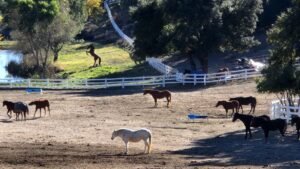 Left: Horses roam on sanctuary land, as shown on the Villa Chardonnay website
Ledda was on-site to help a client retrieve a horse that was never found. She describes a hostile environment where the founder allegedly refused to honor court-ordered photography rights. Ledda said that despite her extensive background, she was “not prepared” for the level of cruelty she encountered, witnessing several animals in the final, agonizing stages of life-ending neglect.
The report details a “barn of horrors” where nearly every animal was emaciated. Ledda observed a donkey gasping and unable to stand, and five different horses whose skeletal outlines were fully visible through their skin. Several of these horses suffered from “fatal laminitis” and were covered in untreated pressure sores that were exposed when their blankets slipped off their bony frames.
Most alarmingly, Ledda reported that there was no food present for any of the barn animals, while elsewhere on the property, ponies were dangerously obese with hooves so neglected they had grown long and curled, causing the animals excruciating pain.
Ledda also documented extreme overcrowding beyond the equine stalls, reporting about 200 cats crammed into a two-car garage where they were seen trampling one another. She concluded that the sanctuary’s management appeared to have no functional knowledge of proper animal husbandry or feeding. Her professional recommendation was immediate intervention by an independent veterinarian, noting that many of the animals were being “tortured” by their conditions and required immediate euthanasia to end their suffering.
“I observed animal cruelty,” Ledda wrote. “The people responsible for allowing these animals to live in this amount of pain and misery, in my expert opinion, have no knowledge of the proper feeding and care for the animals. Otherwise, they would not be suffering like this.”
A video of Villa Chardonnay can be found on YouTube here.
Representatives for Villa Chardonnay have defended the founders, claiming the animals were well cared for. Heidi Redman, a spokesperson for the sanctuary, told reporters there was “no neglect” and that the animals were treated “like their children.”
Redman argued that the confiscated animals are now in crowded facilities and are no better off than they were at the sanctuary. She also noted the founders were devastated that their personal house dogs were also seized during the raid.
Moving forward and how to help
The Julian rescue has highlighted a gap in oversight for animal sanctuaries. Huggins pointed out that there is currently no single state agency tasked with monitoring and regulating facilities like Villa Chardonnay.
There are ongoing legislative efforts, such as Assembly Bill 631, introduced in 2025, which seeks to increase transparency and reporting requirements for animal shelters and rescue groups to prevent issues like the one with Villa Chardonnay.
Below, right: San Diego Humane Society personnel bring rescued animals from Villa Chardonnay in Julian to the Gaines Street campus. (Photo by Karen Pearlman)

Huggins also noted that the sudden influx of animals has pushed SDHS far beyond its capacity.
SDHS is leading an effort for the reunification of animals that may have been boarded at or surrendered to the sanctuary.
Every animal removed from the property is being documented and photographed. Huggins said that anyone who brought animals to Villa Chardonnay and is looking to locate their pets should fill out a form at sdhumane.org/julianrescue
Locals are also being urged to adopt current shelter residents to free up space or donate to fund the massive medical and logistical costs of the Julian operation. Weitzman said the SDHS continues to be over capacity, currently housing more than 2,000 animals at its four locations, including its site in El Cajon, where most of the Villa Chardonnay cats are now receiving care.
For more information, visit the San Diego Humane Society website here.