
Story and photos by Paul Levikow
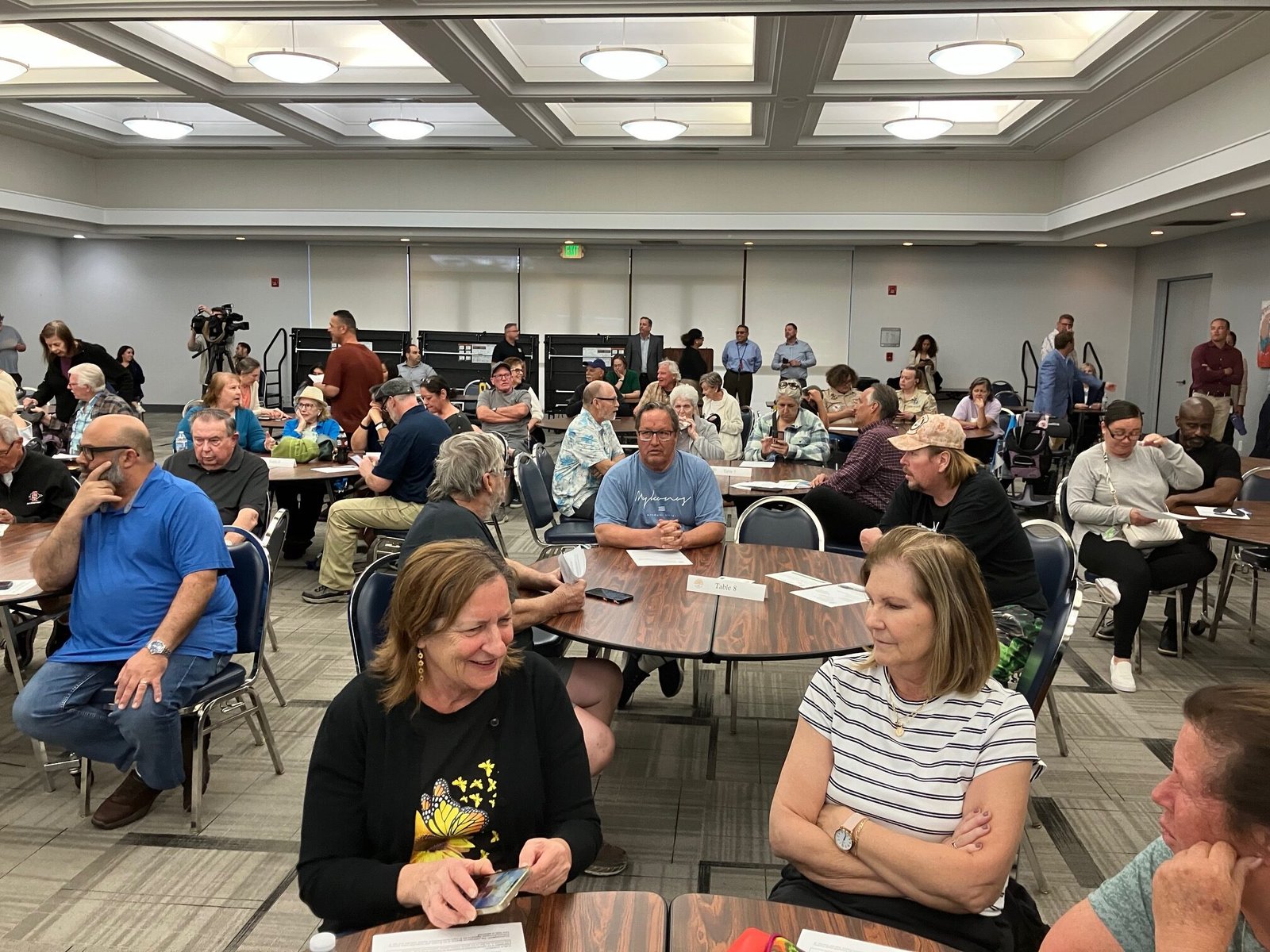
Photo: About 80 residents participated in a El Cajon Town Hall to discuss speeding and traffic issues.
April 30, 2026 (El Cajon) — One of the largest town hall meetings hosted by the City of El Cajon drew about 80 residents on April 21, as city leaders, staff, and law enforcement gathered to address ongoing concerns about speeding and traffic safety.
Held at the Ronald Reagan Community Center, the meeting included participation from the mayor, city council, city officials, police representatives, and media, with a focus on identifying enforcement, education, and engineering strategies to reduce speeding across the city.
Speeding Trends
Traffic data presented by City Manager Graham Mitchell pointed to a concentration of excessive speeding among younger drivers.
“Excessive speeding is clearly a young issue,” Mitchell said, noting that men ages 16 to 35 account for 50% of incidents involving high-speed violations, including driving 65 mph in zones posted for 25, 35, or 45 mph.
Mitchell identified several streets with the highest rates of excessive speeding, including Fletcher Parkway, Jamacha Road, El Cajon Boulevard, Broadway, Washington Avenue, Chase Avenue, and Avocado Avenue.
Five years of crash data on Jamacha Road between the city limits and the Gustavo Street area showed patterns in collision types. Broadside collisions were more frequently caused by drivers averaging 53 years old.
“You are more likely to get broadsided by a female than you are a male,” Mitchell said, attributing many of the incidents to distraction and heavy pedestrian and bicycle activity.
Rear-end collisions, he said, are more commonly caused by men and are often linked to speeding and distracted driving. Men are also more likely to collide with stationary objects such as trees or curbs. Overall, Mitchell reported that 70% of drivers involved in accidents related to speeding are men. A look at citations issued citywide during a five-year period indicated that ECPD writes an average of 183 citation per month for all types of violations. When it came to speeding tickets, officers wrote 30 per month or one a day. There was an average of 61 collisions monthly, 15 hit and run crashes monthly and 11 DUIs every month.
“We have too many people driving fast. Lack of respect. Expensive, fast cars. No accountability. Road rage,” Mitchell said. “How does a city and a society fix that?”
Increased Enforcement
A longtime resident and professional driver identified as Chris addressed the crowd, drawing applause.
“You won’t change human behavior until you change enforcement,” he said.
El Cajon Police Chief Jeremiah Larson outlined current enforcement limitations, noting the department has four motor officers and three traffic units primarily assigned to collisions and hit-and-run incidents.
“We go to the areas where there are the most complaints or where we know there are problems,” Larson said.
He explained that each traffic stop takes about 10 minutes and that motor officers handle multiple responsibilities. “For four people to do enforcement throughout the town is a challenge. So we have to get creative.”
Larson described annual saturation patrols involving approximately 30 officers from agencies across the county and partnerships with the California Highway Patrol and San Diego County Sheriff’s Office for enforcement along routes entering and exiting the city.

“If we had a motor officer that we could post on every corner, speeding would go down. We can’t do that,” Larson said. “Enforcement absolutely works, but it works temporarily.”
Photo, right: El Cajon City Councilmembers listen at a town hall meeting focused on traffic and speeding.
Pilot Program Targets Offenders
Police are piloting a new program using cameras to identify speeding and reckless driving. Vehicle owners will receive warning letters describing violations and potential penalties. The chief noted that state law prohibits issuing citations based on camera evidence alone, including footage captured by drones or fixed systems.
Mayor Bill Wells said the warning letters will outline the financial and legal consequences of violations.
“This is what we caught you doing on camera, and, by the way, this is what it would have cost you had a police officer stopped you for reckless driving,” Wells said, adding that penalties can include significant fines and possible jail time.
“We’re hoping that parents will help us do a lot of the enforcement because I think once mom and dad realize that their children are becoming a public menace, I’m hoping that they will get involved,” Wells said.
He also noted that red light cameras were previously removed in El Cajon due to cost, accident concerns, and public opposition.
Engineering Solutions and Reporting Tools
Mitchell emphasized that roadway design can have a greater impact on driver behavior than enforcement alone. Proposed and considered measures include narrowing streets with paint or curbing, adding stop signs, installing roundabouts or traffic circles, implementing speed-triggered red lights, painting speed limits directly on pavement, adding raised medians, and enhancing crosswalk visibility.
Residents were told that installing speed bumps requires meeting specific criteria and can face neighborhood opposition. City officials also encouraged use of a traffic-specific phone line and a reporting app to identify problem areas. Councilmember Steve Goble reminded attendees about the “My El Cajon” mobile app available for reporting concerns.
Shared Responsibility
Councilmember Gary Kendrick called for restoring driver education in local high schools and emphasized community involvement.
“The public is the council’s eyes and ears. We can’t be everywhere at once,” Kendrick said. “There are things that happen that we don’t know about, but they are important to you and so they’re very important to us.”
Councilmember Phil Ortiz highlighted the need for transparency and realistic expectations.
“Every change that we do there is going to be a trade-off,” Ortiz said. “We have to come into these issues with realistic expectations that there’s no silver bullet.”
He also expressed interest in a zero-tolerance approach to speeding and improved reporting on enforcement locations.
We’re not just going to magically change something,” Ortiz said. “I’m super thankful that everybody is invested in the community enough to show up.”
Councilmember Michelle Metschel urged residents to set an example.
“What I’d like to see is people modeling good behavior for your kids, for your grandkids,” Metschel said. “We just need to be better drivers ourselves.”
Mayor Wells acknowledged the scale of concern.
“We see this is a problem. We hear all your complaints so we know this is a top two or three problem that we’re having in the city now,” he said. “Thank you for your patience.”
Next Meeting Scheduled
A follow-up town hall focused on traffic issues in the Jamacha Road and Gustavo Street area is scheduled for May 21 at 6:30 p.m. at Meridian Elementary School. That meeting will focus on neighborhood-specific concerns rather than citywide issues.
The April 21 event was part of the City Council’s 2026 Action Plan to address speeding through enforcement, education, and engineering solutions, with no formal action taken during the session.