
By Karen Pearlman
May 25, 2026 (Lemon Grove) — Lemon Grove voters will have the final say this November on a measure that would end commercial bird sales in the city, replacing them with a rescue-only model that requires pet stores to source birds exclusively from animal shelters, humane societies or nonprofit rescue organizations. The Lemon Grove City Council voted 3-2 last Tuesday, May 19, to place a citizen-led initiative to ban the commercial sale of birds on the November ballot.
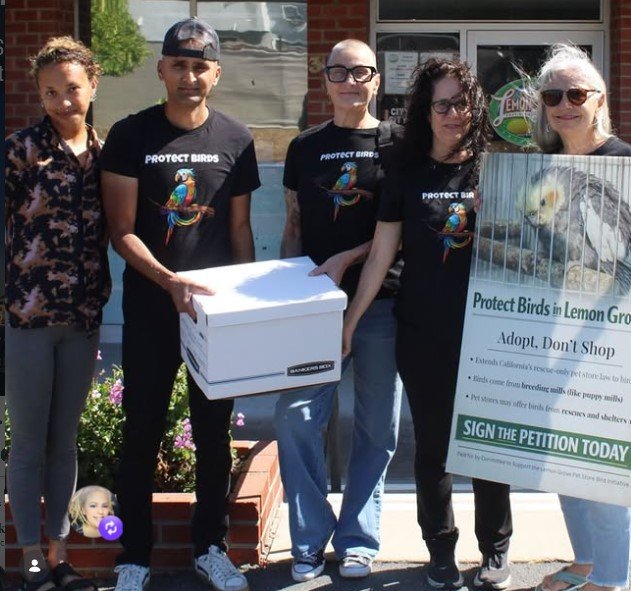
Image: Members of a group that worked to get a citizen’s initiative in front of the Lemon Grove City Council seeking to ban the sale of birds by retailers in the city. Photo courtesy Strategic Action for Animals
The Council had the option to adopt the ordinance outright, send it to the November voters or request a comprehensive impact report.
Proponents of the ban had successfully secured enough signatures (1,699) to have the City Council directly adopt the measure into law, but only Mayor Alysson Snow and City Councilmember Jennifer Mendoza voted to adopt the ordinance without alteration.
The rest of the Council agreed with city staff’s recommendation to allow voters to weigh in — at a cost estimated to be between $25,000 and $50,000 to place the initiative on the ballot.
“I would like to see us save $50,000,” Snow said, suggesting the money would be better used to support opening the local recreation center.
Noting that one in eight registered Lemon Grove voters signed the petition, Snow added, “I think it’s a mandate.”
The initiative would restrict the sale of birds in the city of Lemon Grove, expanding the state of California’s existing retail pet sale protections — which currently apply to dogs, cats and rabbits — to include birds.
The measure explicitly exempts poultry and birds raised for agricultural or backyard flocks.
The initiative targets two local retail establishments:
Lemon Grove Pet Supplies & Exotics, located on Main Street, has been a fixture in the city since 1989 — but according to initiative proponents, it carries a documented history of animal control complaints.
Tropic Island Bird & Supply, which relocated from San Diego to Lemon Grove last year, also has animal control complaints on record, proponents said.
Despite the concerns raised publicly about both establishments, Snow reported that neither store owner has spoken to the City Council or attended any meetings related to the bird sales issue.
Proponents launched the effort last December, when petitioner Vicky Lynn Snow filed a Notice of Intent to Circulate Petition, fueled by concerns regarding the treatment of birds at local commercial establishments.
On May 4, the San Diego County Registrar of Voters officially certified the initiative’s petition results. Out of 2,611 signatures collected across 48 petition sections, the Registrar verified 2,135 signatures and deemed 1,699 valid, meeting the threshold required to qualify for council action.
Mendoza, who shared that she once owned cockatiels and has backyard chickens, was also prepared to enact the ban immediately.
A substitute motion introduced by Councilmember Jessyka Heredia and seconded by councilmember Yadira Altamirano to place the measure on the ballot carried the majority, with councilmember Seth Smith joining them in the 3-2 vote.
“I am a firm believer that I would like the voters to have a say in this,” Heredia said. “I don’t think the signatures alone are necessarily enough to say that this is what the city of Lemon Grove wants to do… I believe in the democratic process.”
Proponents in Lemon Grove several times referred to West Hollywood, which last fall became the first city in the nation to ban the retail sales of amphibians, arachnids, birds, fish, hermit crabs, small mammals and reptiles, in addition to the existing state ban on retail sales of dogs, cats and rabbits. West Hollywood’s ordinance became effective May 1.
Legal considerations
The Council’s legal counsel also injected caution into the debate.
Lemon Grove City Attorney Kristen Steinke flagged potential legal exposure, noting that an affected business owner could attempt to sue the city for damages or “reverse condemnation” by claiming the law stripped away their profitability.
While some Council members questioned whether the city should craft a customized business amortization schedule to mitigate risk, Steinke clarified that the initiative text already provides a built-in cushion: it takes effect immediately upon adoption but delays active enforcement for six months.
Smith noted that letting the measure go to the ballot might actually create a more legally robust defense for the ordinance against future court challenges.
The public weighs in
Several supporters spoke in favor of the bird sales change; no opponents appeared or submitted any correspondence to the city.
Activists cited data showing that retail animal sales make up just 4 percent of the $158 billion domestic pet industry, meaning local shops could easily pivot to selling bird food, cages and higher-margin accessories while hosting adoption events.
Avian experts and local bird sanctuary leaders detailed the gap between commercial supply chains and the biological realities of exotic birds.
“In my work as an avian veterinarian, I regularly treat, especially in springtime, young birds from pet stores who are already seriously ill,” said Dr. Athena Gianopolis, owner of Feathers and Fur Hospital.
Gianopolis described seeing young parrots suffering from infectious disease, malnutrition and severe stress related to early separation and a lack of owner education.
“Tragically, many of these birds die… Pet stores are simply not equipped to provide the level of education and support or medical care to prepare prospective owners,” she said.
Gianopolis said small birds can live 20 to 30 years, while larger parrots can surpass 50 years. Other speakers noted that pet birds are extremely vulnerable to abandonment when consumers realize the scope of the commitment.
Kelly Flynn, director of the Parrot Education and Adoption Center, shared that retail sales without education have turned parrots into the most frequently rehomed pets in the United States, with the average parrot passing through six to seven homes in its lifetime.
Flynn said that PEAC has received 3,114 unique relinquishment requests since 2018. Since Jan. 1 of this year alone, the group has received 92 unique requests — averaging 1.5 owner surrenders per day. By contrast, the rescue can only successfully place about 30 birds into new homes per year.
Isabelle Estrada, Executive Director of Free Flight Exotic Bird Sanctuary in Del Mar, called parrots “intelligent, sentient beings” that deserve better than the cycle of “excessive breeding and excessive poaching.”
The emotional capacity of birds was underscored by Jenna Close, founder of the Jamul-based pigeon rescue Moose’s Flock.
Close shared a story of a rescued pigeon who fell into a deep, observable depression, refusing to touch his food for three days after his mate passed away.
“We cannot know bird emotions, but we do know they have layered and complex emotions,” Close said. “That’s why this initiative matters.”
If approved, Lemon Grove will enlist the San Diego County Department of Animal Services to inspect stores and enforce the ban.