
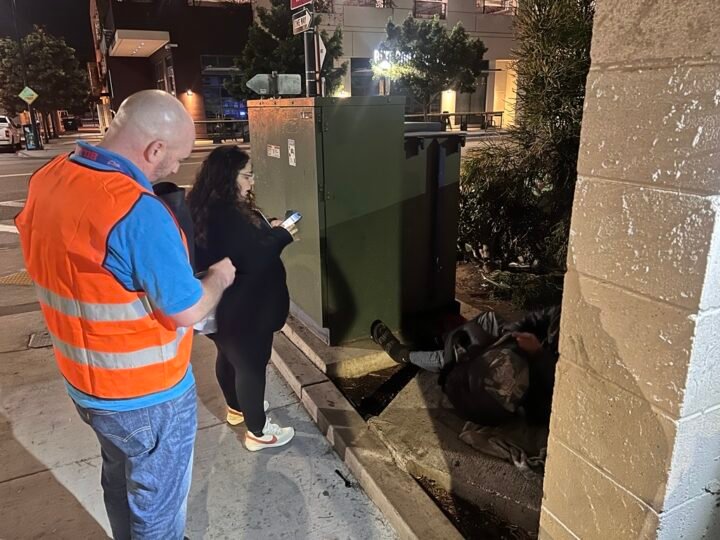
 Photo of volunteers working the Point In Time Count in January courtesy County of San Diego
East County News Service
May 6, 2026 (San Diego County) — San Diego County saw a modest 1 percent decrease in overall homelessness this year, but beneath that is a more encouraging story: Street homelessness dropped 11 percent countywide, driven by targeted state grants, expanded shelter capacity and aggressive multi-agency outreach, especially across East and North County communities.
According to the San Diego Regional Task Force on Homelessness released 2026 We All Count Point-in-Time Count, conducted by nearly 1,700 volunteers in the early morning hours of Jan. 29, there are 9,803 total individuals experiencing homelessness across the county, down from 9,905 in 2025.
One significant concern did emerge from this year’s data: Senior homelessness continues to spike. People over the age of 55 now are 1/3 of the unsheltered population, up from 29 percent last year. More than half of those found unsheltered over age 55 reported that they were experiencing homelessness for the first time.
The number of people living in shelters in 2026 compared to 2025 jumped by 12 percent to 4,695 — what officials say indicate that local housing and diversion programs are gaining traction and moving people off the streets.
Tangible progress is seen in East and North counties, where coordinated investments are bringing results. Additionally, the unincorporated part of the county saw a 16 percent drop in unsheltered populations, with 150 people found.
With homeless encampments along the San Diego River and in transit corridors a longtime part of East County’s makeup, the area surprisingly showed some of the region’s sharpest declines in street homelessness.
In Santee, the unsheltered population dropped 64 percent, from 53 individuals last year to 19 in 2026. County officials credit a highly successful $22 million Encampment Resolution state grant that specifically targeted the San Diego riverbed.
Lemon Grove also saw steep decline, with a 50 percent drop in its unsheltered population — from 110 down to 55. That drop follows a yearlong County outreach effort that connected unhoused residents with housing and shelter services.
Other East County highlights include:
La Mesa: Unsheltered numbers fell by 25 percent (from 52 down to 39). Simultaneously, the city expanded its shelter capacity significantly, bringing 39 people indoors this year compared to just nine in 2025.
El Cajon: The city recorded one of the region’s most dramatic turnarounds, with its unsheltered population falling 39.5 percent, from 344 individuals in 2025 down to 208 in 2026. (That follows a contentious 2025 count that city officials disputed, arguing the figures included people living outside city limits; the methodology was subsequently adjusted.)
Unincorporated East County: Lakeside saw its unsheltered numbers drop nearly 28% (from 47 to 34), while Spring Valley reported a 14 percent decrease (from 106 to 91).
To continue this momentum, the County broke ground last month on the Troy Street Sleeping Cabins in Lemon Grove to provide immediate emergency bridge housing.
North County: Collaborative Task Forces Yield Results
In the North Inland and coastal-adjacent communities, the story was largely one of successful intervention, highlighted by a staggering 76.6 percent drop in San Marcos. The city recorded just seven unsheltered individuals this year, down from 30 in 2025. Officials attribute the success to a joint task force combining resources from the County, the City of San Marcos, local schools and the San Diego County Sheriff’s Department.
Other notable North County statistics include:
Poway: Street homelessness dropped from nine individuals last year to three in 2026.
Escondido: The city’s unsheltered individuals dropped from 307 to 271, and also sheltered 281 people.
Ramona: Unsheltered numbers dipped slightly, from nine down to eight.
While most communities celebrated reductions, a few areas saw slight upticks, underscoring the fluid nature of the crisis.
Vista/Bonsall saw an increase in unsheltered individuals, from 144 to 157, with 133 people were successfully sheltered. Fallbrook’s number of unsheltered individuals rose from 16 to 17 compared to last year.
Other PITC finds
The 2026 count also recorded a 12 percent reduction in unsheltered veterans, a 26 percent decline among transitional-age youth (18–24) and a 14 percent drop in people living in vehicles.
Over the last year, the County distributed $10 million in capital grants to partner cities to stand up localized shelters and operated three safe-parking sites. It also targeted youth homelessness, pouring $3.6 million annually into the Housing Our Youth Program.
The County has invested nearly $1.5 million in diversion funds, including eviction prevention and shallow rental subsidies, to stop people from losing their homes.
Since 2017, leveraging excess County land and the Innovative Housing Trust Fund, the County has invested more than $334 million in affordable housing, creating over 3,445 homes, with another 2,600 currently in development.
Residents looking to track local progress can access the County’s Housing for All Hub at sandiegocounty.gov/content/sdc/housing-hub.html, which offers public dashboards detailing real-time housing data and program metrics across the region.
For more information on the Point In Time Count, visit rtfhsd.org/reports-data/.