
LA MESA GREEN LIGHTS, LEMON GROVE RED LIGHTS DISPENSARY APPLICATIONS 9.3K

Total Views: 39 By Jonathan Goetz Photo: Angeles Nelson (left) opposed the dispensary in Lemon Grove, while Kathleen Harmon (right) supported it April 4, 2018 (San Diego’s East County) — La Mesa will have its first legal medical marijuana dispensary, after a unanimous vote of approval by the City Council on March 27. An appeal challenging the approval was rejected. By contrast, the Lemon Grove City Council voted to deny an application for a dispensary due to proximity to a daycare center. No dispensaries have yet opened in Lemon Grove though at least two have met zoning requirements and are now advancing through the conditional use permit process. Both Councils took the actions recommended by staff in implementing laws established by voter-approved initiatives. At issue in each is the date of completion. La Mesa In La Mesa, one applicant submitted theirs on October 18 with an addition on October 26 while the other submitted a completed application on October 25. Dispensaries raced to see which can get approved first, due to a requirement that they be at least 1,000 feet apart. What a difference a day makes! San Diegrown LLC’s application from October 25 was selected and will be the first medical marijuana dispensary to be sanctioned by the La Mesa City Council (5-0). Another, so far approved, is to be considered under the same appeals process next month. Photo: San Diegrown LLC is expected to begin operating a licensed medical marijuana dispensary after a remodel of 8155 Center Street in La Mesa 91942 Lemon Grove In Lemon Grove, which has distance limits for dispensaries near daycares, a daycare center had lapsed in its paperwork with California. A dispensary application was marked compliant with Lemon Grove Measure V sensitive site municipal code during this time. Subsequently, when the daycare operator’s paperwork was renewed, that approval was revoked. Angeles Nelson, Community Advocate and Project Assistant for the Lemon Grove HEAL Zone, and a Lemon Grove City Commissioner, spoke against the new dispensary. The applicant was Joe Yousif and KIM Investments for the dispensary proposed at 3515 Harris Street. “We are relying on the City Council to protect our kids,” said Nelson. “We understand that the process is complicated and cumbersome, but the bottom line is that there is a childcare facility with kids and the regulation was made specifically to protect them. The dispensary has not completed the application and California state has approved the application for a daycare center. It seems logical for us to uphold the law and protect the children from the dangers of being close to a marijuana dispensary.” Kathleen Harmon, who has a street named after her in San Diego, spoke on behalf of the dispensary, saying, “I am really disturbed about what has happened. I worked with this applicant. I’ve been there and he applied way before the center was recognized so therefore lots of money has been put into this and the City allowed him to go and do this, and I think on behalf of the businesses and the growth of Lemon Grove, I’d hate to see us come out with something like this.” A letter from Austin Legal Group sent to the City on behalf of the dispensary applicants prior to the vote argues that if the city were to deny the application it would violate the law capriciously and throw the zoning process into uncertainties, opening the door for repeated requests for reconsideration of decisions previously made. It is unclear whether the applicant may seek to challenge the Council’s action in court. A motion to reject the appeal, but also allow this applicant to immediately reapply, carried 4-1, with Councilman David Arambula voting against denying the dispensary application. Printer-friendly version
9.3K viewsLEMON GROVE LIKELY TO SEE THREE MARIJUANA DISPENSARIES AS EARLY AS LATE SUMMER 3.1K
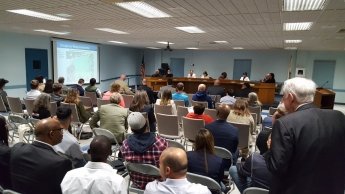
Total Views: 50 By Jonathan Goetz Photo: With exclusions around sensitive sites and each other, it appears three dispensaries will open in the western portion of Lemon Grove along Federal Boulevard March 8, 2017 (Lemon Grove) – Lemon Grove City Council held a public hearing Tuesday about the new medical marijuana dispensary application process that opens March 20th to comply with Measure V, which Lemon Grove voters approved in November legalizing medical cannabis sales. Staff concurred with Councilmember Jennifer Mendoza that the new regulations will allow for an estimated three medical marijuana dispensaries in Lemon Grove, a city of 25,000 people. City Manager Lydia Romero told a room full of people, many of whom wish to submit applications for a conditional use permit (CUP) in Lemon Grove, that information for prospective applicants is available online at the city’s development services page. “It’s just like the process of opening any other business,” Mayor Racquel Vasquez told the East County Magazine. “There is a lot of fear of the unknown, and the Council is ensuring that we protect public safety.” During Council deliberation on marijuana, three people spoke in opposition to the normalization of use and proposed additional language which could be added to the ordinances that staff brings back. A fourth person spoke against placing undue financial burdens on patients. Later in the meeting, Councilmember Jerry Jones responded to one speaker’s concern over a transparent storefront requirement, noting, “Our hands are tied quite a bit by Measure V.“ Jones asked staff, “How are we going to redraw those lines to keep that 1,000 foot radius?” referring to the distance between dispensaries. Romero replied “It’s going to be a race to see who gets theirs approved first.” On the March 20th process opening, City Attorney Jim Lough said, “We take applications in the order they come in; the applications will be out on one day and we will take them in as they come and we will process them just as we do any other permit.” Romero told the audience, “In this case staff is neutral; it is a race to see who gets their application in, whoever follows the rules, whoever works with staff…so it’s incumbent upon applicants to follow all the rules and to do everything right.” Properly completed applications may be approved before earlier applications with information missing. David De Vries, Development Services Director said for each dispensary, a public hearing will be scheduled within 60 days, where Council will make a final decision. The final decision requires a minimum of three affirmative votes. The Council has long shut down unlicensed dispensaries in the past, before voters approved legalization. Two of the public speakers thanked the Council for its successful crackdown on unlicensed dispensaries in the past. Councilman Jones encouraged residents with concerns that are not in the ordinance, “We would like them to bring those things forward.” Romero said she expects a long line of applicants on March 20th, adding, “The earliest we might see a dispensary is late summer, it really just depends on the applicant.” Councilmember Matt Mendoza quipped that it’s strange for him to advocate for more taxes, then asked staff if there was a way to add more taxes to medical marijuana. Staff clarified that Measure V authorizes a per patient quarterly fee to be paid to the city, but excludes other taxation of medical marijuana unless approved by voters. Earlier in the Council meeting, Heartland Fire and Rescue gave an annual report while the San Diego County Sheriff’s Department gave a Lemon Grove Substation 2016 review. This is Lemon Grove’s seventh year with Heartland Fire and Rescue, which has received unusually high quality ratings from the government, scoring in the ninety ninth percentile in official reviews. After hearing Heartland’s Annual Report to the City, Councilmember Jerry Jones voiced hope that Santee join the joint powers authority (JPA). Sheriff’s Lieutenant Chris May gave the 2016 Substation Review. He shared that Lemon Grove has had the second lowest incidence of burglaries in the past three years. He added that Lemon Grove is having a seasonal up-tick in vehicle thefts; when pressed by Jones, May explained this happens when the rains stop and people start leaving windows rolled down. In 2016 there were 20,116 calls for Sheriff services from Lemon Grove, which resulted in 1,112 arrests, increases from historical levels, which upon pressing by the Council, the Lieutenant attributed to the state’s realignment transferring inmates from state prisons to local jails, which in turn resulted in early release of some local prisoners. Mayor Vasquez asked if Lt. May felt only having two Sheriff deputies on duty at a time was enough, to which he replied, “When we need them, we can get as many deputies as we need.” Instead of two deputies at the meeting there were five. Drawing extra deputies from neighboring jurisdictions can be problematic, however, given that manpower is already stretched thin in some adjacent communities, reliable sources have told ECM. During public comments, two people spoke on items not on the agenda. One complained about an abandoned development site that has turned into a landfill and another voiced concerns over alleged rotting dead animals at Lemon Grove Pets. Printer-friendly version
3.1K viewsLA MESA BANS RECREATIONAL POT BUT ALLOWS DELIVERIES; CITY ALSO MOVES TO ALLOW MEDICAL MARIJUANA DISPENSARIES 5.4K

Total Views: 54 By Jonathan Goetz March 7, 2017 (La Mesa) – At its February 28 meeting, the La Mesa City Council spent over an hour learning about and discussing cannabis legislation, following a lengthy introduction by City Attorney Glenn Sabine who consulted a conditional Use Permit (CUP) process and cannabis taxing consultant. You can stream the hour and twenty-one-minute discussion from the City of La Mesa’s website at http://www.cityoflamesa.com/CivicMedia?VID=73# February 28, 2017, minutes 26 to 1:47 The municipal code in La Mesa must be updated in order to comply with Measure U, which La Mesa voters approved to legalize medical marijuana dispensaries. The Council is in the process of updating the municipal code to create a Conditional Use Permit process for these. Council members are also exercising their rights under California’s recently approved Proposition 64. The measure legalized recreational use of weed, but allows municipalities to ban recreational shops. They will not however interfere with deliveries from a licensed facility elsewhere to their residents. The Council is in the process of creating a CUP process for approving prospective medical dispensaries within La Mesa. Approval will be handled as a ministerial action and will be reviewed by the planning commission. If someone appeals the planning commission decision, it will go to the Council for final decision. This will require from the Council at least a 3-2 vote for each dispensary, in which absences have the same effect as a “no.” Dispensaries must comply with being a certain distance from sensitive areas. The Council also banned growing pot plants outdoors in La Mesa because they are concerned about abuses such as people hopping a fence to steal a cash crop. Under California law, medical cannabis is not subject to sales tax. Thus, the Council is directing staff to come up with a weight tax or something else that will pass judicial muster to generate revenues. Councilmember Kristine Alessio wants to require people who want to grow up to six plants to register in a City database or some sort of protection to keep plants away from children. Councilmember Colin Parent opposes such a registry and Councilmember Bill Baber opposes it unless he can be convinced, perhaps on fire risk, of such extreme regulation being necessary for six plants. The City can regulate growing, but a license/registry/database of indoor pot plants seems unlikely, although the city already has two requests for them if it becomes necessary. La Mesa’s ban of outdoor growing gives the Council less room to regulate indoor growing if they are to keep consistent with the spirit of the voter approved law, which they all seem committed to doing. The City Attorney informed the Council that they have the ability to regulate deliveries, but the Council was unanimous in opposing such regulation, although Councilmember Colin Parent appeared perhaps willing to do if that was everyone else’s requirement for opening up shops in La Mesa. Alessio, perhaps the Councilmember most worried about normalization of use, said “delivery is clearly something that people should have the ability to have their dispensary or pharmacy to deliver to them.” She said it shouldn’t be a problem “If I go to the dispensary and I have a card and need to have it delivered the next day…” Parent said, “I think saying no to deliveries and allowing dispensaries is fine,” but proceeded to find the common ground and Council consensus that mobile deliveries would be not be stopped in La Mesa unless they came from an unlicensed source or looked like an ice cream truck, to which everyone agreed. Parent joined with the other four in voting to banning recreational marijuana, but said he thought it should be revisited later. In other news, Council is accepting the lease termination from MacArthur Park and Sun Valley Golf Course management, and is looking for new ways to use the golf course. The Council was unanimous in wanting keeping MacArthur Park and Sun Valley Golf Course open to the public, but perhaps not as a golf course, strengthening and perhaps broadening its appeal. Consensus was to keep the disk golf open, and Parent wants to investigate dining options, to which Alessio quipped, “We don’t want to tell people that we’re taking the park and turning it into a giant restaurant.” Mayor Mark Arapostathis then added, “or a giant helicopter pad, but we have to keep our options open.” Printer-friendly version
5.4K viewsMAYOR FILNER ORDERS HALT TO PROSECUTION OF ZONING CODE VIOLATIONS FOR MEDICAL MARIJUANA DISPENSARIES 10
Total Views: 33 By Miriam Raftery January 10, 2013 (San Diego)– Mayor Bob Filner today announced that he has asked the Neighborhood Code Compliance Department and the Police Department to temporarily halt all prosecutions of city zoning code violations when it comes to medical marijuana dispensaries (letters attached), pending development of new regulations. “As I made very clear during my campaign for Mayor, I support the use of marijuana for medicinal purposes and am committed to ensuring the people who legitimately need it for relief of pain are not kept from accessing it,” Mayor Filner said. “I also want to assure the residents of San Diego that there will be the utmost safeguards surrounding these dispensaries. They will not be near schools, playgrounds or any areas where children might gather. Nor will they be allowed to infringe on the quality of life in any neighborhood.” He added, “I believe that, in order to be a great city, we must also be a humane city and show compassion toward those who need help in dealing with chronic pain.” Filner said he plans to bring a proposed ordinance to regulate medical marijuana dispensaries to the San Diego City Council soon. That’s welcome news to Rudy Reyes, worst-burned victim of the Cedar Fire and an advocate of medical marijuana who sued the County of San Diego over its refusal to issue medical marijuana cards. He won his case in federal appeals court. “I’ve spoken with him many times on the campaign trail…He realizes this is an initiaitve passed by the people 16 years ago and that he has to support what the people said. This is a step in that direction, unlike the County which has gone completely the opposite direction.” Reyes and his attorney, Mark Blumel, who represents the San Diego Medical Marijuana Task Force, have had meetings with the Mayor on the issue, he said. “It’s a big step forward having acknowledge of rights. I personally was raided, and after they dropped charges I realized that people do have rights and started to speak out,” Reyes said. The U.S. Attorney’s office has taken action to shut down clinics in some areas, including East County’s only clinic in unincorporated El Cajon. But Reyes predicts that the federal government is unlikely to conduct raids when not requested by the city attorney, based on recent precedent in San Francisco. San Diego City Attorney Jan Goldsmith has stated that he will abide by the order and further, drop charges against several clinics that were pending. Printer-friendly version
10 viewsMEDICAL MARIJUANA BACKERS HAIL COURT DECISION OVERTURNING CONVICTION OF DISPENSARY OPERATOR IN SAN DIEGO 6K
Total Views: 83 “By rejecting the Attorney General’s argument that patients who utilize dispensaries must collaborate…to cultivate the marijuana they purchase, the court is establishing a clear standard for dispensaries across the state.” –Joe Elford, Chief Counsel, Americans for Safe Access By Nadin Abbott October 26, 2012 (San Diego)—On Wednesday, the Fourth District Court of Appeal for California issued a unanimous ruling overturning the conviction of Jovan Jackson, the operator of Answerdam, a medical marijuana dispensary in Kearny Mesa. The decision is being hailed by medical marijuana advocates as a landmark decision that could have far-reaching impacts for medical marijuana patients and dispensaries. Following a 2007 raid on his dispensary, Jackson was tried for marijuana possession and sale in 2009 but was acquitted by a jury. San Diego District Attorney Bonnie Dumanis tried him again on the same charges following a second raid in 2009. This time, Jackson was denied a defense under the state’s Medical Marijuana Program Act and he was convicted. Superior Court Judge Howard Shore referred to medical marijuana as “dope” and called California’s medical marijuana laws “a scam.” The Appeals court found that he should have been allowed to present a defense and threw out the conviction. Jackson’s lawyer, Lance Rogers, is still waiting to learn if Dumanis will seek to retry the case at trial court. Also yet to be seen is whether California Attorney General Kamala Harris will appeal the Appellate Court’s ruling to the California Supreme Court. What was significant in the ruling, according to Rogers, is that the Court found that “medical marijuana dispensaries can sell it. You can sell medical marijuana at retail and patients under the law are not required to grow their own cannabis.” Rogers spoke at a press conference Friday outside the Hall of Justice in downtown San Diego. Moreover, according to Joe Elford, Chief Counsel for Americans for Safe Access, “By rejecting the Attorney General’s argument that patients who utilize dispensaries must collaborate, or ‘come together’ in ‘some way’ to cultivate the marijuana they purchase, the court is establishing a clear standard for dispensaries across the state.” If there is no appeal to the California Supreme Court, this has now become the law in the State. In finding that Jackson was entitled to a defense, the Court also set a precedent providing elements for a defense in future jury trials. Jackson was sentenced to 180 days in jail, to be served after all appeals. He served 22 days, on a psychiatric evaluation after he tried to represent himself early on because he felt the public defender was not doing a good job. Since then, Jackson has tried to move on with his life and these days he makes his living as a barber. As he told ECM, his life “was thrown into some chaos and waiting for the decisions has been hard.” ECM also asked Rogers about the conflict that exists between federal and state law. It is illegal under Federal Law to have seeds, plants or any other product. This has not changed. But ECM raised the issue of a case in the Washington D.C. courts that is seeking to reschedule marijuana from Schedule I to Schedule II, which would allow it to be prescribed by doctors. The court expects to hear the case within months. Rogers hopes that this rescheduling does happen. Locally, raids in the last two days since the ruling have intensified, said Rogers, adding that there is a list going around telling collectives to close up shop or face the law. We also had a chance to ask about HIPPA, since privacy of patient records are not protected during raids. Rogers said that forms used at the dispensaries are not considered medical records, therefore according to the Courts, there is no violation of privacy rights. Chiefly Rogers affirmed that as a result of the California court ruling, medical marijuana patients “are not criminals.” Further information: Wednesday’s landmark appellate court ruling: http://AmericansForSafeAccess.org/downloads/Jackson_Appeal_Ruling.pdf Jackson appeal brief filed by ASA: http://AmericansForSafeAccess.org/downloads/Jackson_Appeal.pdf Attorney General reply brief: http://AmericansForSafeAccess.org/downloads/Jackson_Appeal_AG_Reply.pdf ASA reply brief: http://AmericansForSafeAccess.org/downloads/Jackson_Appeal_Reply.pdf Printer-friendly version
6K viewsCOUNTY BOARD OF SUPERVISORS TAKES THE HIGH ROAD ON MEDICAL MARIJUANA ISSUES 13
Total Views: 55 By Kyle Serzen June 26, 2009 (San Diego)–The San Diego County Board of Supervisors lit up some controversy during its meeting on Tuesday, which included two medical marijuana issues. The first was a resolution passed unanimously 5-0 to allow patients to apply for a medical marijuana ID card beginning July 6th. The Board also passed a measure asking County Counsel to draft language prohibiting marijuana dispensaries in the County’s unincorporated areas, by a vote of 4-1. In emotionally charged testimony, proponents of medical marijuana testified that it relieves conditions including glaucoma, chronic pain, and nausea from chemotherapy. Some criticized the County for raids and arrests of medical marijuana patients. Others opposed making medical marijuana more easily available, disputing the benefits and expressing concern over decriminalization of the drug. Medical marijuana users will have to pay an annual fee of $166 for the cards. Of that fee, $66 goes to the State, and the remaining $100 is the County’s estimate to compensate for costs of the cards. The County may take up to 30 days to issue the card so that they will have time to verify legitimacy of the prescription and ensure that the prescribing doctor is in good standing with the Medical Board of California. Supervisor Dianne Jacob noted that the resolution creates “a gray area . . . as these cards may provide a false sense of security. Users can still be prosecuted under federal law.” Some medical marijuana patients, while supportive of ID cards, objected to the program being run by the County and suggested privatization. “The issue that I have here is my privacy,” testified Rudy Reyes (photo), a burn victim of the Cedar Fire who instigated litigation to force the County to comply with state laws allowing use of medical marijuana. He referred to the Health Insurance Portability and Accountability Act of 1996 (HIPAA), which protects the privacy of individually identifiable health information. “I have the right to keep my records privatized—not in any governmental hands. We have asked you as the patients of San Diego to find a designee for this program, not the Health Services Department that has held the same prejudices as the County Board of Supervisors.” Others objected to costs of the cards. Wendy Christakes testified she is living on $800 a month and struggling to get by. “People on low income should have fees waived,” she said, adding that she is also concerned about the County transferring information on medical marijuana users to the Department of Motor Vehicles. Jim Redman, executive director of Californians for Drug Free, criticized “permissive drug laws” and opposed medical marijuana cards being issued. He said guidelines issued by Attorney General Jerry Brown have narrow guidelines and some cities and counties are allowing much larger quantities to be possessed by medical marijuana patients than what state law provides. He argued that state law “should not establish a green light for cannabis sales.” The prohibition on medical marijuana dispensaries in the unincorporated areas is targeted only towards for-profit dispensaries, said County Counsel John Sansone. “Cooperatives and collectives are allowed within state law,” he added. “We’ve taken the first step (with the medical marijuana cards). The second step is zoning changes to allow legal access, but to prevent illegal activity in the unincorporated areas,” said Supervisor Pam Slater-Price. Her concerns stem from the high levels of methamphetamine use, drug smuggling, and drug sales that occur in unincorporated areas. But some area residents testified that they fear a continuation in County law enforcement activities which have targeted medical marijuana users and dispensaries. “Every single attempt to operate a cooperative in SD has resulted in an environment of fear,” said Eugene Davidovich. “The DEA has made it clear – SD is not a safe place for cooperatives, and patients are rounded up and arrested.” One patient committed suicide after being arrested, he added. “I beg you to put forth regulations so people know what is legal or not,” Donna Lambert told the Supervisors. Lambert said she has seen “people in wheelchairs, people with canes, growing eight plants that they thought was legal” arrested and that in some cases, “County authorities have “kicked in their door and shoved people to the ground.” Chrissakes provided emotional testimony asking for guidelines for patients and dispensaries. “What am I to do, because I can’t grow cannabis if I’m a mother and CPS will take my children and call me an unfit mother,” she asked, adding, “I’m a conservative person but I refuse to take oxycontin …I could not take care of my children.” Supervisor Ron Roberts, who cast the sole vote against the measure, said that “laws should be clear and easy to follow, but the law being put forward . . . doesn’t do these things and I’m very disappointed.” He pointed out that zoning codes lack provisions for other illegal activities such as illegal gambling, which is illegal regardless of where it takes place. “We need to accept that (Proposition) 215 is the law,” he added. Many speakers present at the hearing claimed that this doesn’t accomplish anything that isn’t already dictated by state law. “Something that’s illegal is illegal” was the refrain of opponents to the measure. However, Sansone noted that this measure will be “an added tool for dealing with illegal dispensaries” because it “adds a civil tool for injunction when criminal laws are not working.” Printer-friendly version
13 views