
 Story and photos by Paul Levikow
April 16, 2026 (Mt. Helix) — The reality of year-round fire season in San Diego’s East County was addressed during a recent wildfire preparedness assessment tour at a Mt. Helix home, where residents gathered to learn practical steps to protect their properties before the next emergency strikes.
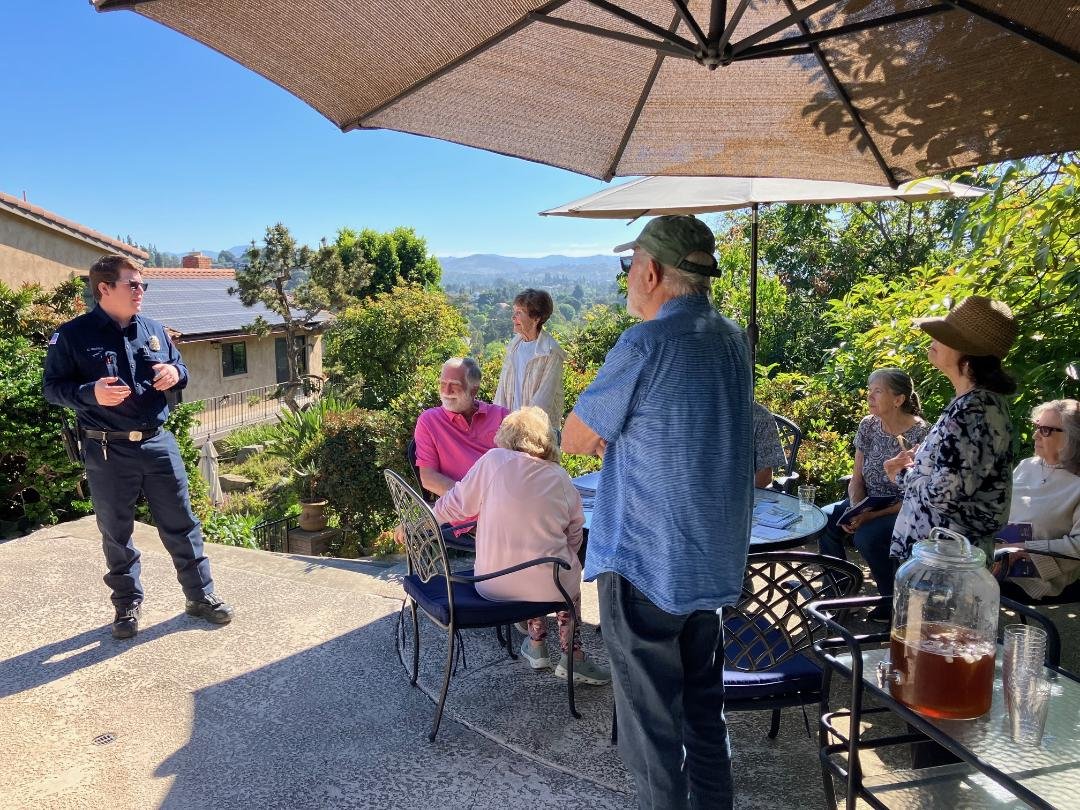
Hosted by the Rancho Helix de Oro Fire Safe Council at the home of co-chair Lidia Chang, the event brought together more than a dozen neighbors for a detailed walk-through led by a San Miguel Fire and Rescue Department fire inspector. The council is part of the Fire Safe Council of San Diego County and plans to hold additional assessment tours later this year.
Participants moved around the property, examining everything from roofing and vents to landscaping and access routes for fire engines. The message throughout was clear. Preparation done months or years in advance often determines whether a home survives when wildfire moves through a community.
Fire Inspector Colton Israels said the lessons shaping today’s wildfire response were learned through devastating experience.

Firefighters in San Diego County learned their lesson from the 2003 and 2007 firestorms and other fires since, he said, referencing disasters that reshaped emergency planning across the region.
“We really need you. When you hear us banging the war drums on defensible space, we’re not sitting there to do that to pick on anyone or to just make noise,” Israels said. “It’s because we had to learn those lessons, sometimes painfully, and we really need your help to help us help you.”
Israels pointed to the 2003 Cedar Fire as a turning point.
“We were the first kids to get our teeth kicked in. What I mean by that is the Cedar Fire in 2003 burning more than 200,000 acres in East County,” he said.
 In the years that followed, San Diego County invested heavily in coordination and communication. The Regional Communications System was activated so first responders and public agencies could communicate seamlessly across jurisdictions. At the time, it was considered the most expensive public safety communications infrastructure project in the world and it remains in use today.
“When the 2007 Witch Fire flared up, they could all communicate with each other but everyone was asking for more help,” Israels said. “That’s when they developed a new resource ordering system (Interagency Resource Ordering Capability, or IROC). It is in use up and down California and in most Western states.”
IROC is a web-based system used by state and federal fire departments to order, track, and mobilize firefighting resources, crews, aircraft, and engines during wildfires. It enables real-time, interagency cooperation, managing more than 10,000 personnel at peak season.
“That allows us to pick up the ‘bat phone’ and say ‘I need help.’ It triggers what’s called the master mutual aid agreement, which every fire department in the state of California has signed,” Israels said. “They will assist in any way possible, to the best of their abilities, any other fire department.”
Even with improved coordination, Israels emphasized that firefighters cannot save every structure without help from property owners.
“If dry brush is growing all the way up to a house, there is nothing firefighters can do to triage the structure and keep flames farther away,” he said. “If you don’t give us that defensible space ahead of time, there is very little we can do, especially in these fast, wind driven fires, it’s a matter of seconds.”
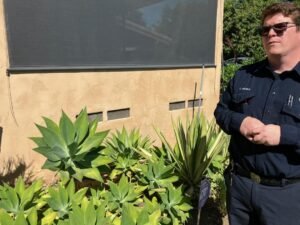
During the tour, Israels highlighted common vulnerabilities and suggested improvements. Trees should be kept at a safe distance from structures, and branches must not overhang roofs.
“You want to keep all limbs or branches that overhang the roof clear. You don’t want them overhanging the roof,” Israels said. “That helps you in both wildfires and wind events so you don’t have anything falling on the house.”
Home construction details can also make a critical difference. Solid, non-vented eaves prevent embers from entering attic spaces.
“Once the fire gets into the attic, the house is a write off,” Israels said.
Dual pane windows, especially those rated for Wildland Urban Interface standards, reduce radiant heat and add a second layer of protection. Ember intrusion through vents remains another major risk, but can be reduced by installing fine mesh coverings designed to resist ignition and block embers.
Decking materials were also discussed, including the use of ignition resistant composite products that are less likely to catch fire during ember storms.
“The key is ignition resistance,” Israels said. “We’re trying to protect homes from a quick, 15-minute assault from these wildfires. There are very few instances in fires where a home has been impacted directly by the flame front for more than that time or the ember assault.”
Landscaping choices around the home play a central role. Residents were advised to remove combustible materials such as mulch and bark within the immediate perimeter of the structure and replace them with non-combustible options like pea gravel, concrete or flagstone extending at least 12 inches from the base of the home.
 Fire officials also stressed the importance of access and visibility. House numbers should be clearly visible at night with bright lighting. Gates must have a key access override to allow firefighters entry, or they may be forced to break through during an emergency. Adequate vertical clearance of 13 feet 6 inches is required to allow fire apparatus to reach structures safely.
Beyond the physical structure, residents were encouraged to take additional steps recommended by fire agencies nationwide. These include preparing emergency go bags, maintaining evacuation plans with multiple routes, signing up for local alert systems, and keeping roofs and gutters free of leaves and debris that can ignite from embers.
Officials also noted that Zone 0 requirements, which apply to homes built after 2020, are now in effect and will eventually extend to older homes, requiring stricter standards in the immediate area surrounding structures.
San Miguel Fire and Rescue offers free home assessments, and local landscapers familiar with defensible space guidelines can help homeowners make necessary improvements.

For those who attended the Mt. Helix tour, the hands-on demonstration brought urgency to a familiar warning. In East County, fire season is no longer a few months out of the year. It is a constant condition shaped by climate, terrain and wind.
Preparation, Israels said, is not optional.
It is the difference between a home that stands and one that is lost.