
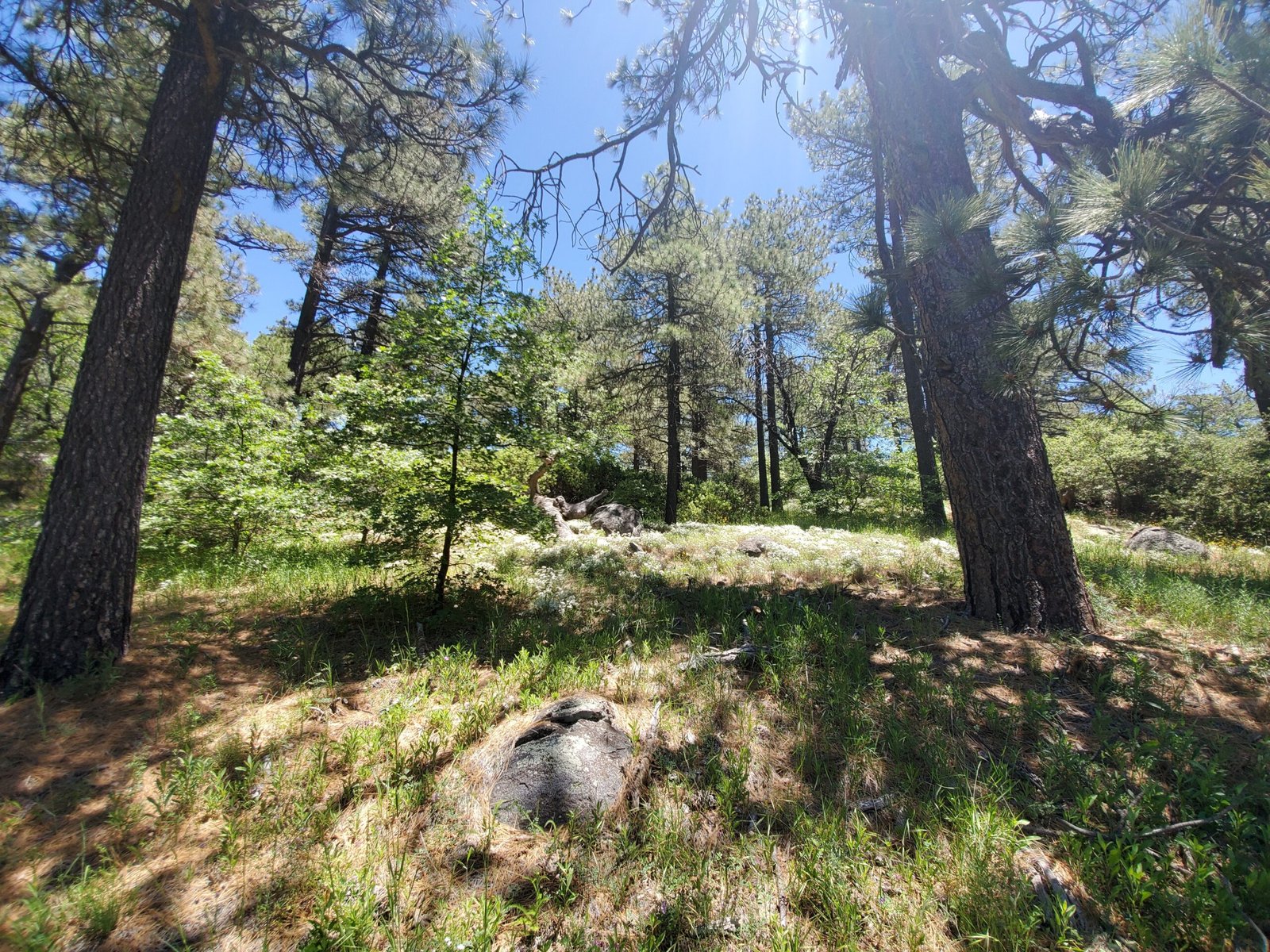
Photo of part of the Laguna Mountains area that could be part of a plan by the government to prevent wildfires by bulldozing the area and cutting down chaparral. Photo by David Hogan, The Chaparral Lands Conservancy
By Karen Pearlman
May 29, 2026 (Mt. Laguna) — A sweeping federal plan to manage more than 13,000 acres of the Laguna Mountains in the Cleveland National Forest in San Diego County is being pitched by the federal government as a necessary restoration to prevent catastrophic wildfires and improve overall forest health.
But local conservationists are slamming the Laguna Mountains Forest Restoration Project, calling it an industrial attack on one of the county’s most cherished wilderness areas.
According to the United States Forest Service, the project is urgently needed to reverse a century of aggressive fire suppression.
Officials argue that successfully stopping small fires for decades has left the mountain plateau unnaturally dense and vulnerable to drought, insect infestations and disease.
The crux of the matter
In a March 20 letter written to “Interested Party” and viewable here, the U.S. Forest Service’s Descanso Ranger District of the Cleveland National Forest wrote:
“The project proposes a suite of forest and meadow restoration activities across the 13,129-acre Laguna Mountain Plateau. These actions aim to restore fire-adapted ecosystem processes, improve forest health and resilience, and address degraded meadow and watershed conditions.
“The purpose of the Laguna Mountains Forest Restoration Project is to restore and maintain forest and meadow health on the Laguna Mountain Plateau. Decades of fire exclusion and changes to natural hydrologic processes have increased risks to human communities, natural resources, and cultural values. The project aims to reintroduce beneficial fire, improve forest structure and resilience, and restore meadow ecological function.
“The project is needed to transition the forest on Laguna Mountain Plateau from a century of fire suppression-focused management to conditions that more resilient to drought, insects, and disease through the reintroduction of low-intensity fire. Because fire suppression has been highly successful at stopping small fires in these forests, the majority of forest acres have now missed two or more cycles of low-to-moderate intensity fires.
“Fire suppressed forests are at higher risk of tree mortality and severe fire than forests where low-intensity fire has been reintroduced.
“Some areas within the project area are currently managed with low-intensity fire and require maintenance treatments on a periodic basis. Other portions of the project area have already experienced severe fire effects from the 2003 Cedar and 2013 Chariot wildfires. Natural recovery has been slow to reestablish native montane forest tree species due to lack of native seed source and competing understory vegetation; therefore, reforestation is needed.
“Proactive meadow restoration is also needed. Meadows play a vital role for supporting the surrounding forests by storing water in meadow soils. These areas are especially important for wildlife, plants, and people during the dry summer months and prolonged periods of drought.”
Treatment plans and vegetation
To lessen the risk to human communities and natural resources, the government has proposed treatments that will include selective tree thinning, shrub density management, the creation of hazardous fuel breaks and the reintroduction of low-intensity prescribed fires.
The plan also includes meadow restoration — such as removing encroaching conifers, fixing gullies and rerouting the Gatos-Chico Ravine Connector Trail — and efforts to replant native conifers in areas still struggling to recover from the devastating 2003 Cedar and 2013 Chariot wildfires.
A coalition of environmental advocates, however, paints a drastically different picture of the project’s impact.
David Hogan, executive director of The Chaparral Lands Conservancy, which is leading opposition to the proposal, argues the entire premise is flawed.
“Contrary to the very lofty title, the project would actually destroy thousands of acres of precious montane ecosystems,” Hogan said. “It’s a deeply misguided and ignorant attempt to recreate tree forest conditions that have never actually existed in the Laguna Mountains.”
Hogan said the project will rely on bulldozers, heavy mastication equipment, chainsaws and herbicides to aggressively clear the landscape.
Below, right: map of proposed area to be cleared, courtesy U.S. Forest Service

Hogan said that public lands shouldn’t be sacrificed to private companies that stand to profit heavily from destroying mountain environments.
A central point of ecological contention between the two sides is the nature of the mountain vegetation itself.
While the USFS points to the need for tree reforestation and forest fuel reduction, opponents argue the government’s core premise is fundamentally false.
“The core premises and justifications for the project are fundamentally false,” Hogan said. “The Forest Service claims thousands of acres of forest are at risk from future wildfires and that recent wildfires burned at uncharacteristically high severity. In fact, the vast majority of the project area is naturally montane chaparral and meadows — not tree forests.
“Decades of science have shown us that high-severity fire is normal in chaparral, and that chaparral will recover so long as fire doesn’t become too frequent.”
Budget incentives, corporate interests
Hogan also pointed to structural incentives within the USFS that may be driving the project forward.
According to the USFS, it has a total available funding pool of about $8.6 billion, including around $7.3 billion in regular and supplemental discretionary funding and nearly $1.3 billion in mandatory appropriations, such as timber receipts, recreation fees and land acquisition funds.
The largest portion of the budget is dedicated to wildfire suppression and risk mitigation, heavily supported by designated wildfire emergency adjustments.
Hogan said that the USFS budget “is fundamentally based on how many acres they manipulate or ‘treat’ in any given fiscal year, so they have a huge incentive to mess around on as many acres as possible.”
“This project will only financially benefit huge corporate tree contractors that know everything about chainsaws and chippers and nothing about sensitive forest meadow and chaparral ecology. It’s all about using, abusing, and extracting — not about conserving.”
For example, according to the California Wildfire and Forest Resilience Task Force, USFS partners directly with large corporate timber companies — such as a $75 million agreement with Sierra Pacific Industries — to construct and maintain interconnected networks of shaded fuel breaks across federal and private lands.
Methods and local examples
The methods proposed by the USFS are another concern. According to Hogan, the project would employ unnecessarily aggressive techniques that will cause irreversible damage to the landscape.
“The project would employ unnecessarily aggressive and destructive methods, including stripping whole mountainsides of chaparral using bulldozers, masticators and herbicides, in areas of vegetation that the Forest Service wrongfully deems to be in competition with trees,” Hogan said.
“The Forest Service’s methods are on full display in the hundred acres of chaparral they recently bulldozed near the popular Garnet Peak Trail just off Sunrise Highway. If you look at that, you see what they have in mind. The systematic and large-scale removal of natural chaparral to plant tree plantations is vandalism, not restoration.”
 Photo, left: Snow in the Laguna Mountains, photo courtesy Mount Laguna Improvement Association website
The Laguna Mountains, rising between 5,000 and 6,100 feet in the backcountry, represent a rare alpine refuge in the region. The area draws thousands of visitors annually from both San Diego and Imperial counties for hiking, horseback riding, mountain biking and snow play in the winter. It offers access to the Pacific Crest Trail.
The region is home to highly sensitive plant and animal species, including the endangered Laguna Mountains Skipper butterfly (found only in the high elevations of the Cleveland National Forest), the Laguna Mountains aster and the California Wild Buckwheat — a plant once thought completely extinct before its rediscovery in 2007.
Previous federal implementation guides for the region have emphasized an “adaptive management” strategy, promising that if treatments like prescribed burning are found to harm sensitive habitats or spread invasive weeds, tactics would be paused or adjusted.
Critics, however, remain unconvinced that the landscape can survive the heavy-handed methods proposed.
A pattern of environmental pushbacks
Hogan said there is a link with the Laguna Mountains proposal to a broader pattern of President Donald Trump-era rollbacks of environmental protections.
One is the 2001 Roadless Area Conservation Rule, enacted by the Bill Clinton administration. That initiative placed nearly 59 million acres of national forest lands off-limits to most commercial logging and road construction. The policy was designed to protect pristine, undeveloped ecosystems from environmental degradation, with exceptions allowed for public safety and forest health
Under Trump, the U.S. Department of Agriculture officially initiated action to rescind the 2001 Roadless Rule in August 2025, moving to strip protections from nearly 45 million acres of undeveloped National Forest System lands.
“It’s daily that there’s another issue about nature conservation from this administration,” Hogan said. “Whether it’s abolishing reservation systems at Yosemite or the repeal of the Roadless Rule — a rule put in place back in the early 2000s to protect areas determined to be roadless on National Forest land, including the Cleveland National Forest, that basically prohibit destructive activities in those areas — Trump is repealing it.
“The driving priority from the Trump administration is to privatize or generate as much money as possible from resource extraction or management of public land. Conservation and preservation are not priorities, or even on the list of their management action.”
While the Laguna Mountains project itself is not directly governed by the Roadless Rule, the context is noteworthy. Last August, the USDA opened a public comment period on rescinding the rule, with the proposed rescission applying to nearly 45 of the 59 million acres of inventoried roadless areas within the National Forest System.
The USFS is looking to the public to review the detailed project descriptions and maps, which are available online here to help identify issues and refine the proposed actions before the environmental analysis is finalized. For information on sharing your thoughts, visit the USFS website here.
The Chaparral Lands Conservancy is asking those concerned to send a letter here to Cleveland National Forest leaders opposing the project.