
 Printer-friendly version

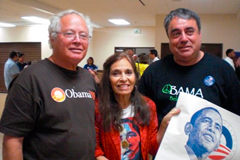 |
| Richard and Rita with Enrique Morones at a joint Latino African American press conference on the day they left for the battleground states. Enrique is the director of Border Angeles, an immigrant rights group in San Diego that provides water and food to immigrants in the desert. |
Kensington residents Richard Griswold and Rita Sanchez are among thousands
of ordinary - or should we say extraordinary - citizens who felt inspired to pull
up stakes and travel to distant states campaigning for Barack Obama.
What’s it like to hit the road and talk to strangers all over the U.S. on behalf
of a presidential candidate? Below is Griswold’s chronicle of this remarkable
saga detailing the memorable places and colorful characters that he and Sanchez
encountered in their journey through the heart of America.
During the last two weeks of the 2008 presidential race, Rita and I decided
to visit battleground states and volunteer in the various Obama campaign offices
that were scattered throughout the Southwest. This decision emerged because
we both had been getting more and more involved in the San Diego campaign as
we went to voter registration drives and Democratic Party Platform meetings
in Chula Vista, and hosted phone banks and political meetings in our home.
Finally in the last weeks of the campaign we felt we had to do more.
We are both semi- retired professors of Chicana/o Studies in San Diego, California
and we have the luxury of begin able to work in the campaign almost full time
and to take off for a few weeks. In the past we had traveled to New Mexico
a lot because Rita’s ancestors are from there, in Bernalillo and Las Cruces,
and she likes to do family research. I love New Mexico for its scenery, food,
people, history, and easy way of living.
This would be a trip of several thousand miles, something I didn’t think about
too much at the beginning but which loomed larger and larger in my mind as
we traveled. Those of you who have driven this route will know what I
mean. There is a lot of beautiful desert separating a few towns and cities. When
you see a political red-blue map of this region and see Utah, for example,
it is solid red. Be assured that geographically most of those living there
may be Republicans but they are outnumbered by gila monsters, snakes, coyotes,
and other desert wild life. There is a lot of uninhabited and beautiful desert
in Aztlan, the homeland of the Aztecs.
Before we left San Diego in the final weeks of the campaign, we went to a
rally and press conference organized by a Latino and African-American coalition. This
was one of the remarkable things about the Obama campaign, that it unified
a tremendous diversity of talented and committed people. Rita gave an impassioned
speech about the importance of Obama for Latino African-American relations.
A labor hall where the press conference took place that morning was packed
with Latinos and African-Americans; some of them we knew from other meetings
and some were old friends, but most were new to us. The joint message
was simple: people of color have a stake in Obama’s victory because he
represents and understands our struggles. Everyone was enthusiastic and excited.
We had to leave right after the press conference to get to Las Vegas before
midnight that day and start work the next morning. A month before, we had gone
to Las Vegas as part of a group from San Diego to work as canvassers. These
are people who go knocking on doors to try to get people to vote early and
to convince undecided voters to vote for Obama. On this second trip we arrived
after enduring several hour-long delays on I-15 due to two major traffic
accidents, one of them a burning van.
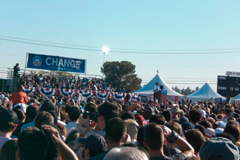 |
| Obama visited Las Vegas, Nevada on his way back from his trip to Hawaii to see his ailing grandmother. They held an impromptu rally for him at a local high school. |
We slept that night in a motel that gave a special rate to Obama volunteers.
Some businesses, small and large unashamedly gave in- kind stuff to the campaign,
discounts, lodging, food, water, and space. If you wore your Obama shirt or
pin and the person serving you in the restaurant or motel was an Obamista,
you were sure to get a smile and a word of encouragement. Very few people we
met were negative about our bumper sticker, shirts and pins.
The next day, Saturday, we found the main Obama office located in a shopping
mall in North Las Vegas, an area of the city where few tourists go - a pocket
of economic misery only a few miles from the over-the-top opulence of the Las
Vegas strip. There were hundreds of volunteers already there; we
signed in and were told to go to another office on the east side of town. Before
we left, a little boy called out for Rita. He was the son of Hameed and Janice,
directors of the Black Contractors Association in Southeast San Diego. Several
months before they had hosted Camp Obama, a weekend training for volunteers
in their spacious modern offices. Rashid has been a key organizer for the Obama
campaign in Southeast San Diego, a predominantly African-American and Latino
section. Over the preceding month they had sponsored joint meetings with Latinos,
house to house voter registration drives, caravans of honking cars with Obama
flags, and a rally organized to begin at Chicano Park, prior to Senator Obama’s
speech before the National Council of La Raza in San Diego in September. In
Las Vegas, Hameed and Janice were there with their family to work some more.
We said goodbye as we drove to the other office. When we arrived there
were about 50 volunteers crowded into a storefront office for training in what
they would be doing that day. We were told that Barack would be arriving
in Las Vegas that afternoon and that if we finished by 2 p.m. we would get
priority tickets to the event.
So Rita and I got our folder with the addresses and names of people we had
to contact and set out for our canvassing location. This time it was a middle
class suburban tract with cul-de-sacs and kids toys in the front yards, in
a predominantly Latino community. This was my first experience in visiting
an all-Latino middle class community; most of my time has been spent in the
barrios of Logan Heights and southeast San Diego or San Ysidro where the vast
majority of people are poor and working class. Las Vegas has been one of the
fastest growing cities in the U.S. and most of the growth has been due to the
in-migration of thousands of Latinos and Mexicans who have been needed to work
in construction and service jobs. The people we were talking to in Las Vegas
were those who had founds good paying jobs, good enough to buy a new house
and fairly new car. Some were day sleepers who worked nights in the casinos.
That weekend we both had the occasion to use our Spanish, a preferred language
for many residents. The lists we were given were the addresses of registered
Democrats and uncommitted voters, so we encountered only very few McCain supporters.
One young man I met had not yet decided who to vote for and told me that he
was skeptical that the candidates would really fulfill their promises. We
had been trained to tell borderline voters our story, why we supported Obama
and to relate to the person’s major concerns by asking them, “What is the most
important issue for you?” My undecided voter was worried about
the lack of experience of Obama but did not like the way the economy was going.
Two things stood out to me as I knocked on doors in this Latino community.
First, how friendly everyone was. No one slammed the door in my face or said
they were too busy. Many wanted to talk about their lives and the candidate.
Obama supporters usually were happy about sharing their enthusiasm. Often they
wanted to speak in Spanish and I would sometimes tell them jokingly as I left, “Obámanos!” It
was a very positive experience. Second, although it was Saturday, lots of people
were not home. They were probably working or at their kid’s soccer games or
visiting friends. These were the working middle class who had managed to buy
their first home in this subdivision.
That afternoon we raced to turn in our completed canvas forms so we could
get to the Obama rally in time. Before we left the campaign office we
met up with a Latino family from San Diego, Marco and Cynthia, Their
daughter and dog who were driving to Washington D.C. in a rented van decorated
with Obama signs. Their plan to was to have a coast to coast mobile advertising
campaign while stopping every now and then to volunteer at Obama offices.
They both were out of work professionals with a daughter about 10 years old.
Their dog, a black Labrador, wore a huge Obama tee shirt. They had built
a web site to advertise their trip, and were doing this on a shoe string.
Their little girl studiously read her French lesson book in the back while
they canvassed. They had contracted with the school district to
continue with her education during the trip. Here was a living embodiment of
the hope that Obama’s candidacy had inspired and that we would see again and
again in our travels.
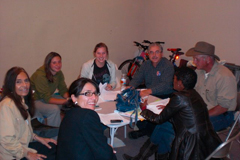 |
| A meeting of campaign workers in Las Vegas, New Mexico on Holloween night. We were planning for the next day's get out the vote canvassing drive. |
We went to the rally, where Senator Obama was to speak at 3 pm at a local
high school. Thousands of people were there in the heat, probably about 90
degrees, outdoors with no shade. We had a hard time finding parking and walking
towards the track field where it was to be held, we passed scores of entrepreneurs
selling Obama inspired tee shirts and other memorabilia like buttons and jewelry. I
hope someone is making a collection of the amazing creative work that his campaign
has inspired; every rally had someone who had designed something new, an image,
a saying, a flyer, a poster, hats, shirts, and so forth. During the campaign
we bought three or four shirts which we wear at different times.
After passing through a security screening we all jammed ourselves into the
outdoor space. The papers said it was about 18,000 people, but it felt like
more. It was during these rallies that the real diversity of Obama’s
appeal was evident. Young, old, black, Latino, Asian, Indian, white. For
me the most emotional image was that of an African American father with his
son on his shoulders patiently waiting to give him a glimpse of Barack, so
he could say he was there when he grew up. Or some elderly wheelchair bound
women, African Americans and whites, who even though they had no chance of
seeing him from their vantage point, were patiently waiting to lend their presence. When
Barack appeared (soon we were referring to him simply as “Barack” when talking
to people door to door, as in “Will you be voting for Barack?”) the excitement
exploded in cheers.
We couldn’t see him because the TV cameras and press stand was in the way
and he was about 75 yards away. Neither could the hundreds of people standing
with us - no one had a chair. We could hear him fine, and everyone strained
forward to try to get a glimpse of him. He had just returned from Hawaii
after visiting his ailing grandmother. One day before the election she would
die of cancer. He told everyone how grateful he was for the cards and
messages of support and then launched into his stump speech which we would
hear a variation of on TV again when he spoke in Albuquerque later that day: America
needed a new economic policy different from that of the last eight years. Americans
were hurting because they did not have health insurance and saw their chance
to educate their children disappearing. Too much partisan division; not enough
unity, he said. We needed to work for everyone, not just to continue
giving advantages to the rich. During the talk, someone in the bleachers
on the other side of the field fainted and he interrupted himself to ask that
a doctor or medic pay attention to this emergency. He asked, “Is that person
OK? We need some medical help here? Is he OK?” To me it spoke
volumes about this man’s priorities and compassion - the individual’s immediate
emergency was more important than his political image. We began leaving
before he finished speaking and heard the rest of the speech as we walked.
Hot, thirsty, and tired we wanted to get a jump on the huge crowd.
The next day Sunday was my birthday, October 26th. After getting
lost (again) we finally found a Catholic church in downtown Las Vegas and then
went to the Obama office for our assignment, another Latino-Mexican suburb
of middle class voters. We worked a half day so we could celebrate my birthday. Rita
wanted me choose and so I picked Excalibur, remembering, I suppose, the time
I went to the jousting sword fighting show with my son Charlie, after my first
wife, Maryann had died. Maybe my memory of that time was more important
than the fact that the place was designed to appeal mainly to 9 year old boys.
This time the serving wenches had been replaced by college boys in levis, the
pewter mugs with bakealite plastic, and roast turkey with Cornish game hen.
In any case it was PG rated, and good fun.
Monday morning, according to my calculations it would be a six hour drive
to Grand Junction Colorado, an easy drive so we could enjoy the scenery on
the way. Little did I know that a traffic jam in Las Vegas and numbing miles
on the road meant that we would make it to Grand Junction that night, at about
7 p.m. Somehow my calculations were wrong all throughout the trip. Even
so, We passed thorough Utah, a red state, with no problem. Very friendly people
and very cheap gas. We discretely did not wear our Obama shirts and hoped
our bumper sticker didn’t attract too much attention.
The next day we started to leave for Denver when Rita suggested we should
not miss Colorado’s Grand Canyon located near by so we decided to make the
detour. As we headed up the mountain to the viewpoint a beautiful long-horned
sheep blocked our road. He stood there for what seemed a long time looking
at us before moving on, a magnificent creature.
After touring the overlooks we headed for Denver, passing through the
Rockies where the leaves were turning bright yellow and the mountains were
lightly dusted with snow. It had snowed a week before this although it was
late October. We stopped briefly in Vail for some very trendy tea and coffee
($10.50) and I got a snap shot of Rita putting some lipstick on a large bronze
moose sculpture (recalling putting lipstick on the pig). We called the Obama
headquarters from there and got directions. The Obama volunteers offered to
find lodging for us that night and when we arrived we met with some of the
staffers who gave us the address to the Colorado couple who had offered to
put us up during our visit. So that night we visited the home of
Max and Susan who live in a sprawling ranch type house near the Obama office.
They turned out to be local political activists. Susan, an artist and
a graphic designer, had created most of the flyers and signs for the local
candidates. She also ran a phone bank and was some kind of coordinator for
local charities in the area. Her husband Max was a computer consultant who
was deeply involved in local politics. He attended lots of meetings and was
studying city planning with the hopes of someday running for office. Their
house had about 20 yard signs for various candidates and a huge HOPE poster
of Obama in their living room widow facing the street. Susan and Max
would be our hosts for three nights in Denver. We stayed in their son’s
room on a fold out couch. He was away at college but his room was still decorated
with his passions for rock climbing and outdoor sports. Hosting us was
also a dog - a beagle, and a cat that passed through our room to use the pet
door to go outside at night. They were friendly enough and largely ignored
us while we slept. Barney did get really excited when we came home from
precinct walking and we both liked having a pet for a few days.
The next day, Tuesday, we went back to the Obama Office, a hub of activity. At
this point I should say that the Obama offices all seemed to be staffed with
young students or graduates from California’s universities. Some were
professionals who had taken off from careers or who had just graduated from
college. Every office had lots of homemade signs and charts indicating
various kinds of work to be done, including a countdown to election day. There
were of course posters and photos everywhere, computers for phone bankers,
and lots of paper and temporary files, all the disarray was like that of a
college dorm room. Every office had a food section with locally donated
food ranging from granola to chili. We had some wonderful green chili
enchiladas in the Obama office in Bernalillo and some great green chili stew
in Las Vegas, New Mexico. A more cynical person might have visited the offices
just to get free food. Everyone was upbeat, busy, and, dare I say, idealistic,
welcoming new volunteers with open arms and thanking us for our efforts. Back
in San Diego we had learned that as organizers we needed to constantly thank
volunteers and never take them for granted. We got thanked a lot and thanked
people back in return.
One thing I learned from this campaign was that their philosophy was one that
emphasized that everyone’s contribution would be recognized, no matter how
small. At Camp Obama we were told to thank everyone over and over again. Even
the smallest effort added up to the total, so there was no pressure to work
or produce a quota. The slogan of the campaign for the coordinators and volunteers
was, “Include, Respect, and Empower” and it really summarized the tone
of the campaign. Somewhere along the way we had learned that early in the campaign
Senator Obama had agreed to run for president as long as there would be no
drama. This meant that he did not expect people to get riled up or over involved
in their egos. I guess the IMPORTANT thing was that he did not want any
drama queens or kings. Over and over the message was that the campaign
was not about him or the prestige of the leaders and volunteers but about us,
the people.
So I never felt bad because we weren’t able to work longer or visit one more
block. We did what we could do given the limits of our time and energy. I should
say that we are both over 65 and semi retired although I have to say that Rita
is often judged to be a lot younger and in fact she is a lot more enthusiastic
and ambitious than I in most things. So she urged us on despite the heat, which
was almost 90 degrees in Denver, unusual for late October. We met up with the
people block by block. At one house we encountered a family of eight Latinas,
all related, sisters, daughters, mothers, and grandmothers. All were enthusiastically
Obamistas but only one was registered to vote, AS a few were visiting, and
the rest were too young. We talked about life in Denver and their family. The
thing about canvassing is that it gives you a chance to talk to a wide variety
of people and they will tell you their story.
I remember one elderly Anglo American man living in North Las Vegas amid the
poverty and abandoned houses who invited me into this apartment when I told
him I was a volunteer working for Obama’s campaign. We were told not to go
into people’s homes for safety reasons, but sometimes it seemed like the right
thing to do. In this case it was 106 degrees outside and the guy seemed to
be my age. I could take him if I had to. Inside I saw that his living room
was decorated with movie posters, including an autographed one of Bob Dylan. When
I asked him who he was voting for, he burst into tears. After a few moments
he apologized and told me that he had embarrassed himself. I muttered a few
things about how times were hard and he had nothing to be ashamed about because
lots of people were hurting. He never did tell me why he cried but only
with great composure and a list of reasons told me that he was voting for Obama.
He finished by saying, “I’d rather vote for Donald Duck than McCain.” Obviously
a show business type. I was really moved by the depth of loneliness, despair,
and needs of some of the people I met at the door. For some people,
I am sure, I was the first person to actually speak to them in a long time.
After some logistical problems, like not being able to find streets and addresses,
we finished most of our assigned area that first day in Denver. I should
say that Rita and I canvassed together, that is, we drove to the assigned street
and often drove between houses, sometimes going together to the door but most
often alternating visits. As you might imagine there were some heightened moments
of discussion when we collectively missed a house or street. Sometimes
we offered each other advise on what we should say or not say. We had
the advantage of sharing experiences and in allocating visits according to
type of voter (the print out identified the voter by party affiliation, age,
sex, and whether or not they needed to be convinced, whether or not they had
a mail ballot in their possession. There were lots of things to cover
and take note of but frequently we covered only the essentials, like asking,
have you voted? If not will you early vote? Will you vote for the
Democratic Senator Mark Udall? Will you volunteer? Most often,
though, no one was home and we would leave a flyer.
We got to know Max and Susan our hosts but only between their constant comings
and goings to meetings and visits with volunteers. They were both working,
Susan from home at her design job, and Max, it appeared was working on a new
consulting contract, but their main priorities seemed to be the election
campaign. Every morning Susan left some homemade muffins, coffee, and
juice out [every morning]. She also left the Denver paper which carried
the news of how the campaign was going. I learned that while we were there,
early voters were massive in their turn out and that most of them were for
Obama. Strangely, a large piece of the pie of early voters were for third party
candidates. That worried me a bit. Who were these people? Green
Party supporters? Libertarians? Supporters of Ron Paul and Ralph
Nader? Did they take away from Republicans mostly or Democrats? If
the election was close in Colorado would this be important? As it turned
out they were not important in the final count that determined the Electoral
College allocation. Besides the polls were heavily in Obama’s favor.
The next day Rita and I worked another suburb of Denver and then went to find
a new Obama office that I had learned about from calling Julie Rodriguez, the
granddaughter of Cesar Chavez who was working in Denver. I had gotten her number
from our friend Enrique Morones who had spent some time in Denver the week
before among Latino organizers. Julie and a group of about
fifty UFW volunteers had come to Denver to help the campaign. Just that
day they had opened an office in one of the barrios of Denver. Julie
introduced us to the staff of young Latinos, most of them from Los Angeles. Julie
was a director of the Cesar Chavez Foundation. As she talked to us she was
busy making a schedule for the coming weekend when they would be walking the
Latino districts. We met a Latina realtor whose office had donated the space
for the Obamistas. She came in and said, “ have an hour until my kick
boxing class, can I do anything, phone? Walk a few houses? Give
me something to do.”
She had not only donated the office, given some food for volunteers, but also
offered US free lodging OR to anyone ELSE who needed it. She was full
of and energy and optimism that overwhelmed even the college kids in the room. She
almost made us want to go out and do another hour of canvassing. But we had
an appointment to take our hosts out to dinner to show our thanks for their
putting up with us. Before we left the barrio Obama office, Julie I called
a couple of friends in San Diego to urge them to spread the word that if they
could get to Denver this weekend; they could get free housing and work with
the UFW volunteers for the final push of the campaign. In retrospect
it may have appeared to them that I was being a bit too presumptive, assuming
that anyone could give up a weekend and leap on a plane at their own expense
and fly off to Denver only because I had called. Being around Obama volunteers,
the high energy of “Yes, we can” was rubbing off.
We took Max and Susan out to dinner that night - a New Mexican restaurant called
Julia Blackbird located in their old neighborhood. The owner was a Midwestern
woman who had married a Latino who was the cook. She and her 10 years-old son
were waiting tables. Inevitably we asked about how she was voting and she revealed
her support for Obama. Her son especially was enthusiastic because the kids
at his school were wearing Obama shirts and pins and he wanted one. Unfortunately
we didn’t have any left but we did have a large cardboard Obama yard sign.
This kind of questioning had become an obsession with us as we traveled, no
matter who it was: a service station attendant, the guy at the front desk of
the motel, a stranger on the street who we asked for directions; we inevitably
asked if they were supporting Barack. Everyone we asked said yes. I remember
one person saying that I should keep his support quiet because no one else
he worked with was pro Obama. This would be called the reverse Bradley effect
- telling the poll taker that you back McCain but secretly voting for Obama. All
this working class support for Obama was a sign of things to come. The name
of the co-owner of the restaurant was Julia herself and she told us that for
months business had been terrible but that she hoped with Obama as president
things would get better. After dinner she gave the four of us free deserts.
That happened only once during our trip, unfortunately.
The next morning we said our goodbyes to Max, Susan, the dog and cat. When
we left them we exchanged phones and addresses along with several hugs and
we promised to host them if they ever came to San Diego. In my experience
that exchange hardly ever happens but who knows, maybe during the next Obama
campaign we will meet up again. Our car set out for I-25 the freeway that would
take us to Santa Fe, New Mexico. Again I estimated (wrongly) that we could
get there in four or five hours.
Our first detour was to visit the Focus on the Family Center in Colorado Springs.
Rita, even though a devout Catholic all her life, has followed the radio
programs of the protestant minister James Dobson as he offers advice on family
life and child rearing. His messages are always in the context
of Christian morality. The campus as they call it, is a huge, almost
opulent, complex with an art gallery, bookstore, cafeteria, soda fountain,
indoor play area for kids, meeting halls and so forth. We were careful to remove
the Obama buttons from our clothes as we entered the spotless building because
Dobson is a firm supporter of John Mc Cain and is against Obama. The main issue
they oppose is Obama’s position on pro-choice. Obama supports Roe v.
Wade, the Supreme Court’s decision making anti-abortion laws unconstitutional.
Rita had been agonizing all during the campaign on this issue about whether
she could in conscience support Obama because of his pro-choice views. She
is against abortion but had learned that the Catholic Church’s position was
that voters needed to consider the totality of the programs of both candidates
as to how they affected life, from conception to death, not just focus on one
issue. Also she learned that both McCain and Palin were not totally against
abortion. Both allowed for the exceptions of rape, incest, and a mother’s health
and both wanted to delegate the power to make abortion laws to the states
which meant that some states would still have legal abortion. This appeared
to both of us to be a blurry position, not clearly pro-life. In any case
at the Family Center in Colorado Springs, I saw the photos and plaques of Dobson
with Bush whom he had endorsed for both his terms. To be fair Dobson did later
criticize Bush for his inaction when it came to anti-abortion measures.
We went into the bookstore and browsed for a few books picking up a free newspaper
published by the center. Driving away Rita read me one of the essays
that argued that the economic downturn had been caused by undocumented immigrants
defaulting on their home loans. This along with the various conservative talk
show programs we heard to make the miles go by reminded us that not everyone
was part of our political world. There are a lot of nuts out there.
We continued on toward Santa Fe and made our next stop for lunch in the Colorado
mining town of Trinidad. I thought finding a Mexican restaurant would
be easy, but we had a hard time. Even though most of the residents are Hispanos
they evidently prefer home cooking to Mexican restaurants. We were the
only customers in the small roadside café called El Rodeo some miles from the
interstate. It was run by a couple, again a Midwestern woman married
to a Hispano man. I am tempted at this point to note the cosmic coincidence
that Obama too is a mestizo, the product of a Midwestern white woman and a
person of color. The middle aged woman served us and inevitably we asked
who she was voting for. “My religion doesn’t allow me to” was her answer.
She was a Seventh Day Adventist and I didn’t know that they were against political
involvement, although it makes sense if they believe in the corruption of this
world and its eminent destruction. Nevertheless we had a good conversation.
She and her husband had been trying to sell the restaurant but so far had no
takers and it didn’t look promising. Just out of habit we told her about Obama’s
tax cuts for the middle class anyway, how his programs might help her. No
conversion took place but she was happy to have a customer and some friendly
conversation.
We had almost forgotten that today was Halloween but as we drove down Trinidad’s
main street it is hard to miss the hundreds of squirrels, rabbits, skunks,
demons, angels, and vampires that were roaming from shop to shop, the smallest
ones in tow by a mother, father, or sister dressed as a clown, bat, or soldier.
It was Friday about 3 p.m. and the streets were clogged with kids getting their
treats from the local businesses. Later I found out that many of these towns
have ordinances against trick or treating after dark because of safety concerns.
In any case, it was beautiful to see all the Latino kids having so much fun.
I didn’t see any political costumes.
Rita has been in touch with an organizer in Las Vegas, New Mexico which is
about one hour north of Santa Fe, so we decided to stop in Las Vegas for the
night and work there the next day. Our first stop when we arrived was the Obama
headquarters located on the old Plaza. Las Vegas, New Mexico is a predominately
Hispano town that was the center for the cattle industry in the 1880s made
prosperous by a railroad connection. In old Las Vegas the Obama
organizers had rented a large series of suites in a building that was probably
120 years old.
Again we were met with chirpy enthusiasm by A Stanford grad who Rita bonded
with since she is one too, class of ‘72. She found out that many of the young
staffers were also Stanford students and alumni and were already planning on
meeting up for a beer at the Big Game after the Obama victory in November.
We were told that Saturday we could help canvas neighborhoods to get people
to do early voting. They invited us to a precinct leader’s meeting they were
having in a half hour.
Meanwhile we ate some delicious green chili stew and quesadillas from a local
merchant and watched the beginning of a CNN segment on Michelle Obama. At the
meeting we got to meet some of the working volunteers in Las Vegas, an African
American professor at the local college, a cowboy replete with a wide brimmed
hat, a Latina mom, and Pablo, a middle-age soft spoken man. Pablo
asked Rita and I to go with him the next day in canvassing the first precinct
and then later tried to talk us into going with him and his wife to canvas
Santa Rosa, a small town sixty miles away. We told him that we had
to decline his last offer because we had already made arrangements to meet
up with my cousin, Mike in Santa Fe the next day. After the meeting,
we checked into the Las Vegas, New Mexico Plaza Hotel, a five-story 1880 vintage
building on the across from the Obama headquarters. Since it was Halloween
they had a country-style band in the lobby and a group of locals watching and
sometimes dancing. Did I mention that throughout this trip either
Rita or I had colds, runny noses, sneezes, coughs and the like. We were
both at the end of the cycle about now and unfortunately I did not feel like
dancing. Next time.
Bright and early Saturday we met up with about 100 other volunteers and got
our packets to walk the precincts. It turns out that almost every registered
voter on our Las Vegas lists was a Democrat and so the biggest challenge was
to get them to vote. Today was the last day for early voting so we were to
urge them to vote today. Pablo showed up and we went in his truck. He was a
medical doctor who worked at the local mental hospital. A perfect match for
us, I thought silently. Pablo took us to the first precinct, which was
the historic district of Las Vegas, the very place they filmed the last scenes
of “No Country for Old Men.” As I walked I kept thinking
of the car crash at the end.
Again most people were not home - where do people go at 10 a.m. Saturday? We
found a lot of people who had already voted and Rita got to talk to a local who
had one of her family names, perhaps he was a distant relative. Mr. Valdes
was uncommitted when we began talking to him but with Rita’s enthusiasm he
soon began to change his mind. Rita has spent a lot of time doing geneology
in New Mexico and knows hundreds of family links. Most people in New Mexico
are cousins of some degree. Maybe the family connection was a factor but it
seemed that, as is true in New Mexico especially, family won out and he agreed
to support Obama. After about three hours, Pablo had to leave to go to Santa
Rosa to continue his work there and we had to get going to Santa Fe. So
after a brief lunch of a red chili bowl and sopapillas in a café unchanged
from 1956 we hit the freeway for Santa Fe at last.
The challenge now arose that we had to stop talking politics in public. This
was because we both agreed that my cousin Mike and his wife Lorin were most
probably McCain supporters being conservative evangelical Christians. They
might not appreciate our enthusiasm. I love my cousin and his family with three
adorable kids and I respect him too much to try to convert him, knowing his
dedication. So we met for a delicious dinner at Tomasitas, the local’s
favorite spot, and then we walked to the Plaza afterwards for some hot chocolate.
Actually after eating, sleeping, walking, and talking politics for a week it
was nice to have a reason to stop. The next day after Mass at our
Lady of Guadalupe, we couldn’t help but visit the local Obama headquarters
in Santa Fe. Again we saw lots of youthful enthusiasm, signs and activity even
though it was Sunday at 11 a.m. Again, free food. Using the uni-sex bathroom
I saw a poster with Barack’s photo saying, “He puts the seat down every time.” The
campaign extends everywhere.
That afternoon we spent a restful time visiting cousin Mike and his family
in his new secluded adobe home located near the Santa Fe Opera. Mike fixed
lunch while Lorin, who is a native Santa Fean talked with us about local history,
the Oñate controversy, where a 17th century conquistador’s statute set off
anti-Spanish reactions among liberals who have sided with native American
activists. Mike told us how the newcomers to Santa Fe want to modernize
the architecture of the city. They hate the quaint adobe look and want a more
metropolitan feel. I said that would be like “killing the goose that laid the
golden egg.” Trite but true. We talked about my family history, and our
mutual ancestors, the del Castillos. Mike’s mom, my aunt Margie, had given
him photos of my grandparents before she died. My grand parents Julio and Bertha
del Castillo, were married in Mexico city in 1921 and Julio had been
a furniture dealer there. Mike loves antiques and old things and has
an enormous collection of Pueblo Indian and Navajo art as well as New Mexican
santeros, folk carvings, and paintings. Their kids are home schooled by Lorin,
and as a result they seem to be miles ahead of others their age, reciting the
Hebrew alphabet, and the two youngest playing a classical piano piece for us
before we left.
Rita and I have traveled to New Mexico lots of times, especially to Bernalillo,
a small town just north of Albuquerque, evidently the oldest standing Spanish
land grant and one of the first Hispano settlements in the valley. Her father
was born there and moved to San Bernardino with his ten brothers and
sisters during the early 1900s when his father went to work for the railroad. Sunday
as we leave my cousin’s house in Santa Fe I know we will stop at Bernalillo
for a visit, we always do. It is All Saints Day, November 2, and
just as we arrive I turn into the Bernalillo cemetery so we can try to find
her great grandfather’s grave. Several hot summers ago along with Rita’s
sisters we found Santiago Sanchez’s grave (B. 1847-D. 1917 ) marked by an iron
crucifix bordered by concrete. I’m not sure we can find it again. The
cemetery has no grass and many of the graves are unmarked. But we locate
his final resting place right away in the fading daylight and Rita gets to
pray there for a few minutes next to a great grandfather who she had only heard
stories about. In his day, the idea of electing an African American to
the U.S. presidency would have seemed incomprehensible. I suspect,
though, that, if he were alive, he would have voted for him as are most of
the Hispanos in northern New Mexico.
We leave to check out the local Obama headquarters in Bernalillo, located
on the main street in town. It is located in a large modern building
that had been built in the last few years. It is staffed by a mix of
senior citizens, pueblo Indians, California college students and locals. We
are asked to try the red and green enchiladas, Christmas style, they call it,
while we talk about how things are going. We took a few photos with fellow
volunteers. Everyone in town is voting for Obama we are told, as one field
organizer comes in and announces that his new information is that Obama leads
in New Mexico with 57 percent of the vote. This is two days before the election
and that turns out to be pretty much the margin of victory.
Rita was excited to meet two volunteers from Sandia Pueblo since that was an
Indian village where her ancestors had attended church in for marriages, christenings,
and funerals. Two twenty-something Pueblo Indian women have a table with a
large sign above them, “PUEBLOS FOR OBAMA.” Bernalillo,
located in Sandoval County has many pueblo Indian villages and we have visited
them all. The two women are from a nearby Pueblo tell us that they
have been canvassing the Indian villages. I don’t recall ever seeing
street signs or addresses in the villages, but maybe I missed them. In any
case this emphasizes again how wide the Obama campaign has cast its net. Everyone
is upbeat and they have lots of posters and photos. A recent one showing
an Obama picnic for the locals caught my eye. Rita always wants to find
elders who might remember her father’s family, but so far never has. By now
it is unlikely that anyone is alive who will remember her grandparents who
moved to San Bernardino nearly one hundred years ago. Nevertheless she
is disappointed that we can’t stay longer to canvass the town she holds dear
so she can talk to people about her family.
We hope to get back to San Diego on election day in time to watch the election
returns with friends and family, so we have to push on. It usually takes us
at least two days to travel from Santa Fe to San Diego, stopping in either
Flagstaff or Phoenix. I called Paul and Marta Espinosa, friends
who teach at Arizona State University in the Chicana/o Studies department,
and They invited us to stay with them in Phoenix on Monday night. Paul
and Marta used to live a few blocks from us in San Diego. They both got jobs
at ASU a few years ago and moved there. Marta is a well known Spanish and Chicana
Literature professor with several books and Paul is documentary film
maker who has lots of credits among them, “Los Mineros,” “The U.S. Mexican
War,” “The Lemon Grove Incident,” and a score of other films. They
are both strong Obamistas and live a few miles from Senator McCain’s home surrounded
by Republicans.
After having slept in Albuquerque we head for Arizona, another red state,
and cross the border without incident. We have heard that the Obama campaign
has been stepping up its effort to get voters here, so much so that McCain’s
campaign has had to invest in making “robo calls” or automatic phone calls
to Arizona residents to tell them of how Obama would be bad for them. On the
way, we stop in Gallup for some red and green chili which we had neglected
to buy sooner.
I got a copy of the local Navajo newspaper, which had election news on its
front page along with a story on how McCain’s policies had been bad for Indians,
criticizing his lack of action on the Big Mountain issues on Hopi lands. This
complicated controversy has been around for ten years involving traditional
tribal elders who are opposing the modernization elements who want to take
away tribal lands for development. Rita meets a Navajo woman who says
that she is not for abortion, and believes Obama when he says that he only
voted “no” on a late abortion ban because of missing language to protect the
life of the mother. She tells Rita that criticism of Obama’s pro life stand
has been too harsh. A Navajo Indian man asks me for a dollar as we leave the
chili store. I give it to him - a down payment on a future Obama stimulus
package I hope. I also wonder if any changes in the economy can change
the poverty that the Navajo nation has endured for so long.
We arrive in Phoenix about seven p.m. and before we go to Paul and Marta’s
house Rita wants to check out the stores in downtown Scottsdale, an upper class
enclave. We end up in a swanky Mexican fashion boutique with two Mexicana
sales girls, one feeding a baby in a car seat amidst the designer dresses and
accessories. The girl with the baby sees our Obama badges and tells
us that she supports him too but that everyone here is a Republican and a racist
too so she has to keep quiet. They can’t vote but hope he will
win. They are in the belly of the beast so to speak.
Paul and Marta are wonderful hosts and invite us out to diner right as soon
as we arrive. We go to a trendy restaurant located in a newly built section
of Scottsdale talk politics most of the night as we eat. Phoenix and
Las Vegas, Nevada are the fastest growing cities in the west and both are located
in the hottest regions of the country, far from water. They both are
in the midst of serious economic downturns in housing and jobs. The new populations
they have attracted to build and maintain the new developments are mostly Latino
and they are the most likely to be laid off when things get rough. Paul
has followed the election very closely and tells us of the various twists and
turns that have happened while we have been away from MSNBC and CNN. That night
back at their house we watch Saturday Night Live’s Presidential Special, a
collection of skits they have done on the presidential campaigns past and present. For
some reason now, one day from the election, it seems not that funny.
After that program, by accident, we saw the first election returns from Vermont.
Due to them being three time zones away a small village near the Canadian border
has a ritual of voting together at the stroke of midnight. The national media
was there in force and we watched as the 21 Vermont voters all went into their
21 voting booths. They tabulated the vote in a few minutes. The first returns: Obama
15, McCain 6. An omen, we hope of things to come.
The next morning, about 6:30 a.m. we sneak out of Paul and Marta’s home so
we can be sure to get back to San Diego before the first returns come in from
the east coast. We have the advantage of the time change at the California
border, setting out clocks back an hour. In Gila Bend, Arizona we stop
for breakfast at The Atomic Café and are shy about wearing our badges although
this dusty cotton- growing town had a huge Mexican population during the harvest
time. The full-time jobs are mostly held by Anglos. I think they suspect
we are Obamistas as we leave.
On the way home Rita tells me that she wants to organize an election watch
party at our house when we return. I argue that I would rather go to one of
the hotels where they have already organized election parties but she suspects
my argument hides my real reason, that I don’t want to clean house and start
shopping and cooking food after unpacking from this trip. As is the custom,
Rita’s reasoning prevails in matters like this and that’s what we do, inviting
close friends and family to show up about 5 p.m. I now am glad that we
did it this way because we got to share food with family and friends and also
to share the victory, proclaimed by all the networks about 8 p.m.
The declaration of the win started while Rita was chopping onions in the kitchen
and some one yelled, “Colorado went for Obama.” In rapid succession
other states followed, New Mexico, Nevada. “Get Mama out of the kitchen,” Rita’s
daughter Lucia yelled. We all watched in rapt attention as John McCain gave
his concession speech and then, before a massive crowd OF 100,000 in Chicago
when Barack Obama gave his victory speech. We were stunned by the
rapid final ending of this drama that had taken two years to unfold. Later
we learned that all the swing states we had visited had gone for Obama. Nevada,
Colorado, and New Mexico all by more than five percentage points. Maybe we
were responsible for a few of those votes, but surely the hundreds of volunteers
and dedicated staff members we had met along the way were the real heroes of
this victory.
All partisanship aside, I know we are on the right side when a group of unemployed
construction workers, a family of Latinas of various immigration status,
a medical doctor, college students, a Pueblo Indian woman, a Mexican
shop girl, countless numbers of students, professionals, and African Americans
all told us of their hope for change with the election of Barack Obama. Our
trip gave us a rare chance to see people of America united by this political
candidate. For the first time in my life I felt a closeness and solidarity
with thousands of Americans of all classes, races, ethnicities and conditions. The
future will tell if this support, expressed by more than 52 million voters
will result in a more perfect union.






Recent comments